
PhyxUp Health Launches AI-Powered Billing Solution Built for RTM and Outpatient Practices
#HealthTech--PhyxUp Health, a healthcare AI company building an intelligent operating platform for outpatient practices, today announced the launch of PhyxUp Billing, an AI-powered billing solution de...
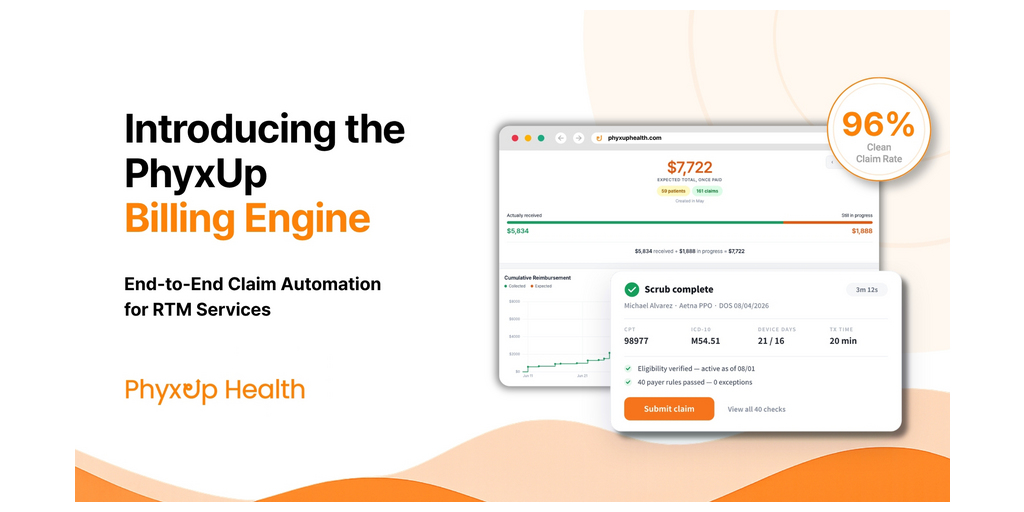



- New billing engine automates eligibility verification, claim generation, claim validation, submission, and payment tracking for Remote Therapeutic Monitoring
- PhyxUp is expanding from RTM workflow automation into a broader AI operating platform for outpatient practice management and revenue cycle operations
SAN FRANCISCO: #HealthTech--PhyxUp Health, a healthcare AI company building an intelligent operating platform for outpatient practices, today announced the launch of PhyxUp Billing, an AI-powered billing solution designed to automate the complex revenue cycle workflows behind Remote Therapeutic Monitoring, or RTM.
PhyxUp Billing connects clinical activity, patient engagement, billing requirements, and payer workflows in a single system. The platform automates key steps across the claims lifecycle, including eligibility and benefits verification, claim generation, pre submission validation, claim submission, claim status tracking, and payment monitoring.
The new billing solution builds on PhyxUp’s existing RTM platform, which is used by outpatient rehabilitation practices to manage patients between visits, track qualifying RTM activity, document treatment management, and support reimbursement.
Rather than treating RTM billing as a separate administrative process, PhyxUp connects the data generated during care directly to the revenue cycle.
Purpose Built for RTM Billing
RTM reimbursement can be operationally complex.
Practices need to track multiple data points across each billing period, including device usage days, treatment management time, patient and provider communication, dates of service, diagnosis codes, and CPT specific requirements.
Much of this information is often spread across clinical systems, patient engagement tools, spreadsheets, and billing software.
PhyxUp was built around this workflow.
The platform continuously tracks RTM activity and converts qualifying clinical and operational data into claim ready information. PhyxUp Billing currently supports six RTM CPT codes and automatically populates more than 30 claim fields using data already captured within the platform.
Before submission, the billing engine runs more than 40 validation checks across patient information, insurance data, CPT codes, ICD 10 diagnosis codes, dates of service, and RTM specific billing requirements.
Claims that meet the required criteria can move forward through the workflow. Claims with missing information or potential issues are automatically routed for additional review.
This allows billing teams to move away from manually reviewing every RTM claim and toward an exception based workflow, where software handles routine claims and staff focus on cases that require human attention.
From Eligibility to Reimbursement in One Workflow
PhyxUp Billing is designed to manage the full operational workflow around an RTM claim.
The solution currently includes:
- Eligibility and benefits verification to confirm coverage before enrollment and billing
- Automated charge and claim generation based on RTM activity captured in PhyxUp
- Pre-submission claim validation and claim edits
- RTM specific billing rule checks
- Exception based work queues for claims requiring additional review
- Electronic claim submission
- Claim status tracking
- Payment and remittance tracking
By bringing these workflows together, PhyxUp provides practices visibility from patient enrollment and RTM activity through claim submission and reimbursement.
The company’s goal is to reduce the number of administrative steps required between delivering care and getting paid.
Reducing Manual Work in the Revenue Cycle
In early deployments with U.S. outpatient practices, PhyxUp has automated approximately 85% of routine RTM billing workflows.
The company estimates that the billing engine has reduced the amount of manual review required from billing teams by approximately 80%.
During a two-month pilot, average claim preparation time decreased from approximately 10 minutes to about 3 minutes per patient.
PhyxUp also reported a claim success rate of up to 96% during the pilot period.
The company attributes the improvement to its ability to validate claims before submission and identify missing information earlier in the revenue cycle.
Instead of waiting for a payer rejection or denial, PhyxUp’s billing engine is built to catch potential issues before the claim is sent.
RTM as the Starting Point for a Broader AI Operating Platform
While PhyxUp Billing is currently optimized for RTM, the company sees RTM as the starting point for a broader opportunity in outpatient healthcare.
RTM requires practices to coordinate clinical documentation, patient engagement, ongoing monitoring, billing rules, staff workflows, and reimbursement over time. This makes it one of the more operationally complex workflows in outpatient rehabilitation.
By building infrastructure around that complexity, PhyxUp has developed a foundation that can extend into broader revenue cycle and practice management workflows.
Over time, the company plans to expand across areas including eligibility, charge capture, coding, claim submission, denial prevention, denial management, remittance processing, payment reconciliation, patient management, and other practice operations.
The broader vision is to create an AI-powered operating system for outpatient practices, where clinical, administrative, and financial workflows can operate together in a single system with significantly less manual work.
Rather than building separate point solutions for each administrative task, PhyxUp is designing a platform where data captured during patient care can automatically drive the next operational or financial action.
“RTM is a good example of how fragmented healthcare operations can become,” said Sangwon Lim, Founder and CEO of PhyxUp Health. “A practice may deliver the care correctly, but someone still has to track activity, confirm billing requirements, prepare the claim, validate it, submit it, and follow the payment.”
“Our goal is to automate that entire workflow. With PhyxUp, the data generated during care can directly drive the billing process, so practices do not have to recreate the same information later.”
Lim added, “We are starting with RTM because it is an area where we have deep workflow and billing expertise. But the opportunity is much larger. We believe the same AI infrastructure can eventually automate a significant portion of practice management and revenue cycle operations across outpatient healthcare.”
About PhyxUp Health
PhyxUp Health is a healthcare AI company building an intelligent operating platform for outpatient practices.
PhyxUp was founded in 2024 by Sangwon Lim, a former physical therapist and epidemiologist who earned her M.S. in Epidemiology from the Harvard T.H. Chan School of Public Health. The company initially focused on rehabilitation and Remote Therapeutic Monitoring, where it developed deep expertise in clinical workflows, patient engagement, and reimbursement.
Today, PhyxUp combines RTM workflow automation, AI-powered billing, patient management, and practice operations in a single platform designed to reduce administrative work and help outpatient providers run more efficiently.
Fonte: Business Wire
Related news

Last News
RSA at Cybertech Europe 2024
Alaa Abdul Nabi, Vice President, Sales International at RSA presents the innovations the vendor brings to Cybertech as part of a passwordless vision for…
Italian Security Awards 2024: G11 Media honours the best of Italian cybersecurity
G11 Media's SecurityOpenLab magazine rewards excellence in cybersecurity: the best vendors based on user votes
How Austria is making its AI ecosystem grow
Always keeping an European perspective, Austria has developed a thriving AI ecosystem that now can attract talents and companies from other countries
Sparkle and Telsy test Quantum Key Distribution in practice
Successfully completing a Proof of Concept implementation in Athens, the two Italian companies prove that QKD can be easily implemented also in pre-existing…
Most read
ServiceNow delivers industry-first personal enterprise agent and policy…
NVIDIA GTC — ServiceNow (NYSE: NOW), the Super Intelligence Control Tower for business reinvention, today announced significant updates designed to bring…
Wyze Scale Ultra BodyScan Plus Puts Your Full Body Breakdown at Eye Level
Wyze, a company dedicated to making smart home technology accessible and safe, today announced the Wyze Scale Ultra BodyScan Plus, launching as part of…
Realbotix to Exhibit at CES 2027
Realbotix Corp. (TSX-V: XBOT) (Frankfurt: 76M0.F) (OTC: XBOTF) (“Realbotix” or the “Company”), a leading developer of humanoid robots and AI systems,…
JFrog Ends the Audit Scramble: Delivers New DevGovOps Capabilities with…
$FROG #AI--swampUP Europe 2026 – JFrog Ltd. (“JFrog”) (NASDAQ: FROG), the Liquid Software company and creators of the JFrog Software Supply Chain Platform,…
G11 Media Networks

InnovationOpenLab is a channel of BitCity, a newspaper registered at the court of Como ,
n. 21/2007 del
11/10/2007- Registration ROC n. 15698
G11 MEDIA S.R.L.
Registered office Via NUOVA VALASSINA, 4 22046 MERONE (CO) - P.IVA/C.F.03062910132
Como business register n. 03062910132 - REA n. 293834 CAPITALE SOCIALE Euro 30.000 i.v.