Digitate Research: Agentic AI Accelerates the Shift to Autonomous IT
Enterprises across North America are entering a new phase of enterprise maturity as Agentic AI redefines the role of IT from a cost center to drive measurable business value and autonomous operations,...



Research study finds enterprises’ AI strategies and implementations are delivering ROI as organizations embrace intelligent systems on their path to becoming autonomous
SANTA CLARA, Calif.: Enterprises across North America are entering a new phase of enterprise maturity as Agentic AI redefines the role of IT from a cost center to drive measurable business value and autonomous operations, according to the latest research report, Agentic AI and the Future of Enterprise IT, published by Digitate, a leading global Agentic AI platform provider for autonomous IT operations.
Drawing on responses from 600 IT decision-makers across the U.S. and Canada, the 2025 study, conducted by Sapio Research, builds on Digitate’s 2023 (US) and 2024 (Europe) studies, revealing near-universal AI adoption and growing maturity have increased trust levels and progress toward Agentic AI systems, unlocking measurable business value and returns on investment (ROI) that position IT as a foundational building block of the autonomous enterprise.
Key Findings
- Generative AI leads the pack: GenAI remains the most widely deployed model (74%), while over two in five have already introduced agentic (44%) or agent-based AI (43%).
- Multiple AI tools are in use: Every organization surveyed has implemented AI in the last two years, using an average of five AI tools across multiple functions.
- AI trust runs high: 94% of organizations consider AI trustworthy, dipping to 87% in sensitive sectors like healthcare and government.
- The autonomous enterprise accelerates: 45% of enterprises operate semi- to fully autonomous today, a number projected to reach 74% by 2030, with 53% expecting to be fully autonomous.
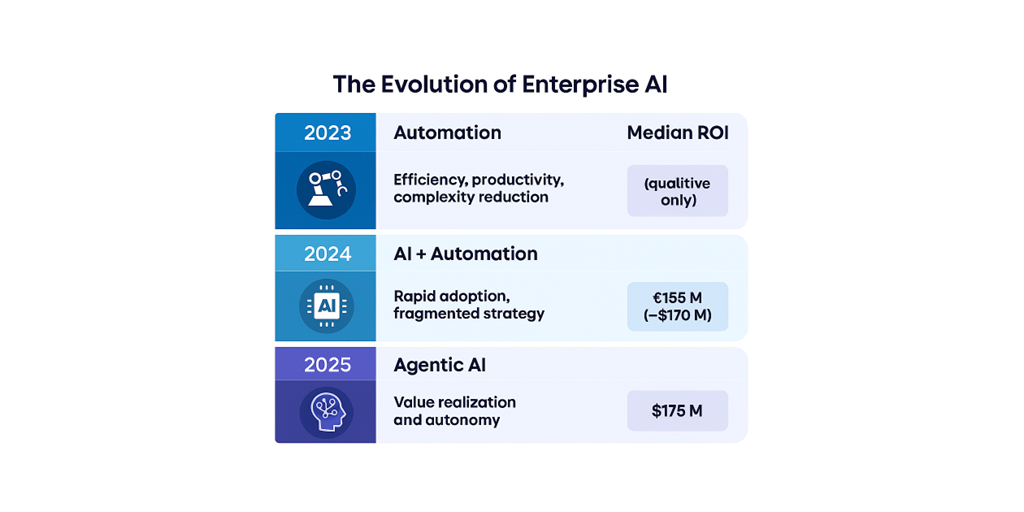
- Strong ROI validated: Median returns of $175M on $71.6M AI implementation spend.
- ITOps leads AI adoption: 78% deploy AI in ITOps, where 65% see greatest benefits, followed by software development (52%) and business intelligence (51%).
- Agentic AI augments human-AI collaboration: 67% find Agentic AI most useful in ITOps, while 62% expect it to assist new functions, with only 25% foreseeing job replacement.
- Operational excellence drives value: Improved accuracy (44%), enhanced efficiency (43%), and stronger data management (42%) are cited as the top realized benefits.
From Automation to Autonomous: A Three-Year Trajectory
Digitate's latest findings mark the culmination of a three-year global research initiative tracking enterprise AI maturity across North America (U.S. and Canada) and seven European regions (Benelux, Finland, France, Germany, Sweden, Switzerland, and the United Kingdom), and what began as a drive for automation efficiency has evolved into a strategy for measurable ROI.
Diving deeper into the findings, since 2023, AI adoption has risen, with organizations on average now leveraging five AI tools. Generative AI (GenAI) is most widely deployed (74%), while over two in five have already introduced Agentic (44%) or agent-based AI (43%). North America leads in both ROI and scale-up, while Europe continues to lead in governance and ethical oversight, complementary maturity paths that balance velocity and resilience.
The IT Function Becomes a Strategic Engine
Across all industries, ITOps remains the proving ground for AI success. While almost half of organizations (46%) still view IT as a cost center today, they expect this perception to shift toward profit generation within 2-3 years. High-investment enterprises (>$500M) report the greatest ROI, showing a direct link between scale and strategic value as AI earns its stripes.
Organizations prioritize AI solutions that enhance accuracy (54%) and offer personalization (51%), indicating that functionality outweighs transparency features in driving adoption, at least for now.
Agentic AI: Augmenting Human Capabilities
Most organizations are adopting an AI-human collaboration mindset, with over half of respondents seeing Agentic AI as changing essential tasks (52%) and enabling full departmental reorganization (53%) while enhancing human work to improve accuracy, efficiency, and productivity.
Major use cases for AI agents in the next 12 months include cost optimization (65%) and proactive issue management (55%). AI agents have proven most successful in enabling customer self-service (49%) and reporting/analytics (48%), the only two functions where agents are considered more useful than traditional AI tools.
The key takeaway here is that this evolution unlocks a higher level of accuracy, agility, and business performance that positions IT as a value creator rather than just a service provider.
Strategic Tensions: Leadership Optimism, Operational Realism, and the Cost-Human Paradox
Digitate's 2025 dataset reveals diverging perspectives and persistent challenges that highlight the complexity of AI transformation. At the organizational level, a "strategy-execution gap" is emerging: C-suite executives (96%) show slightly higher trust in AI than non-executives (94%), tied to greater visibility into ROI and outcomes. Executives focus on profitability and ROI, while practitioners prioritize efficiency and accuracy. The top barriers diverge as well, as leaders cite governance and cost control, while operational teams emphasize technical skills and integration.
AI optimism rises with seniority, but realism grows with proximity. The real advantage comes when both perspectives inform a unified strategy.
That unified strategy must also navigate a delicate balancing act: despite widespread success, 94% of organizations cite drawbacks with AI tools they have already implemented, with human intervention (47%), cost of implementation and maintenance (42%), and ongoing oversight topping the list. Almost all (96%) face adoption obstacles, primarily due to a lack of technical skills or the need to upskill staff (33%), followed by a lack of budget to implement AI (31%). Indeed, the rising cost of technology (42%) ranks as the second biggest external threat after cybersecurity (49%).
The irony is structural: organizations are deploying AI to address these very pressures, using it to reduce IT complexity (28%), enhance profitability (22%), and improve productivity (22%), yet their dependency on skilled human input persists. AI is viewed as a remedy for both rising costs and human constraints, yet those very forces limit its scalability. The winners will be organizations that balance automation with augmentation, optimizing cost without eroding the human expertise that powers AI's success.
The Autonomous Horizon
Looking ahead to 2030, the research reveals a clear trajectory:
- Nearly three-quarters of enterprises expect to be semi- or fully autonomous by 2030.
- AI-driven performance metrics will evolve from uptime and cost reduction to profitability, resilience, and innovation velocity.
- Success will hinge on investment in upskilling, integration, and responsible AI governance.
"In just three years, AI has moved from an operational utility to a strategic capability - one that's trusted, governed, and measurable,” commented Avi Bhagtani, Chief Marketing Officer, Digitate. ”AI maturity is accelerating the shift to the autonomous enterprise, enabling effective human-AI collaboration, and proving that IT is a driver of tangible business outcomes. Organizations have moved from experimenting with automation to scaling AI for meaningful and sustained impact."
To access Digitate’s Agentic AI and the Future of Enterprise IT report, click here.
About the Report:
Conducted by Sapio Research in September-October 2025, the study surveyed 600 IT decision-makers across the U.S. and Canada from enterprises with 1,000+ employees that have implemented AI in the past two years. The findings are accurate to ±4% at the 95% confidence level. This 2025 edition follows Digitate's prior North American (2023) and Europe (2024) surveys, forming a longitudinal dataset on enterprise AI evolution.
About Digitate:
Digitate builds AI technologies to power the autonomous enterprise. Our Agentic AI platform – ignio™ – combines unified observability, AI-powered insights, and closed-loop automation to help enterprises across industries operate smarter, faster, and with greater resilience. Trusted by leading global enterprises and innovators, ignio accelerates innovation and maximizes business outcomes. Learn more at www.digitate.com and follow Digitate on X and LinkedIn.
Fonte: Business Wire
Related news

Last News
RSA at Cybertech Europe 2024
Alaa Abdul Nabi, Vice President, Sales International at RSA presents the innovations the vendor brings to Cybertech as part of a passwordless vision for…
Italian Security Awards 2024: G11 Media honours the best of Italian cybersecurity
G11 Media's SecurityOpenLab magazine rewards excellence in cybersecurity: the best vendors based on user votes
How Austria is making its AI ecosystem grow
Always keeping an European perspective, Austria has developed a thriving AI ecosystem that now can attract talents and companies from other countries
Sparkle and Telsy test Quantum Key Distribution in practice
Successfully completing a Proof of Concept implementation in Athens, the two Italian companies prove that QKD can be easily implemented also in pre-existing…
Most read
ServiceNow delivers industry-first personal enterprise agent and policy…
NVIDIA GTC — ServiceNow (NYSE: NOW), the Super Intelligence Control Tower for business reinvention, today announced significant updates designed to bring…
eClinicalWorks and healow Announce Record Revenues Exceeding $1.3 Billion…
#AI--At the 2026 eClinicalWorks and healow National Conference, eClinicalWorks®, one of the largest privately held healthcare technology companies in…
Wyze Scale Ultra BodyScan Plus Puts Your Full Body Breakdown at Eye Level
Wyze, a company dedicated to making smart home technology accessible and safe, today announced the Wyze Scale Ultra BodyScan Plus, launching as part of…
JFrog Ends the Audit Scramble: Delivers New DevGovOps Capabilities with…
$FROG #AI--swampUP Europe 2026 – JFrog Ltd. (“JFrog”) (NASDAQ: FROG), the Liquid Software company and creators of the JFrog Software Supply Chain Platform,…
G11 Media Networks

InnovationOpenLab is a channel of BitCity, a newspaper registered at the court of Como ,
n. 21/2007 del
11/10/2007- Registration ROC n. 15698
G11 MEDIA S.R.L.
Registered office Via NUOVA VALASSINA, 4 22046 MERONE (CO) - P.IVA/C.F.03062910132
Como business register n. 03062910132 - REA n. 293834 CAPITALE SOCIALE Euro 30.000 i.v.