Omdia: Global Cloud Infrastructure Spending Hits $102.6 Billion, up 25% in Q3 2025
#Cloud--According to new research from Omdia, global spending on cloud infrastructure services reached $102.6 billion in Q3 2025, representing 25% year-on-year growth. Market momentum remained stable,...



LONDON: #Cloud--According to new research from Omdia, global spending on cloud infrastructure services reached $102.6 billion in Q3 2025, representing 25% year-on-year growth. Market momentum remained stable, marking the fifth consecutive quarter in which growth has remained above 20% highlighting continued strength across the sector. This performance reflects a significant shift in the technology landscape as enterprise demand for AI moves beyond early experimentation toward scaled production deployment. As this transition accelerates, hyperscalers are increasingly redirecting competition away from the incremental gains in model performance and toward platform-level capabilities that support multi-model deployment and ensure the reliable operation of AI agents in real-world environments.
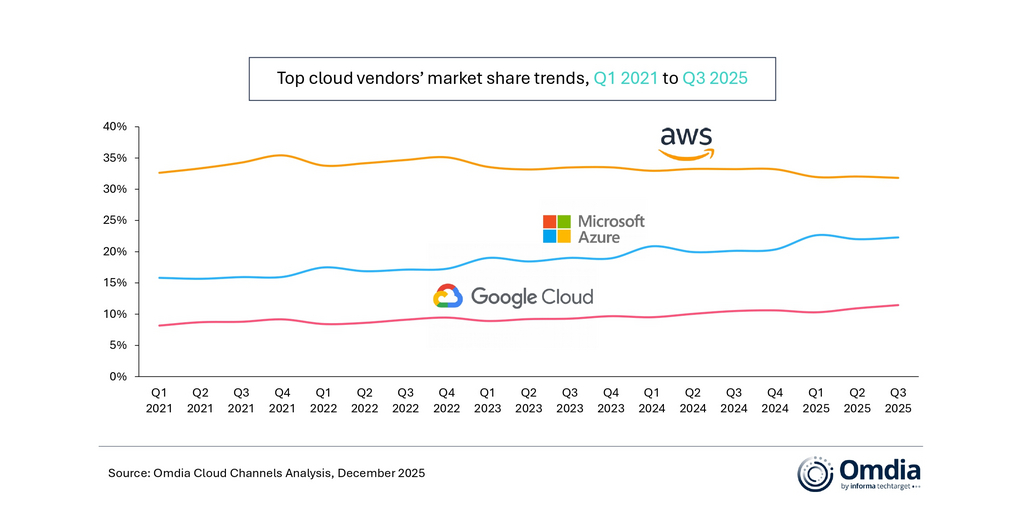
In Q3 2025, AWS, Microsoft Azure, and Google Cloud maintained their market rankings from the previous quarter, collectively accounting for 66% of global cloud infrastructure spending. Together, the three hyperscalers delivered 29% year-on-year growth.
AWS’s growth reaccelerated to 20% year on year quartering Q3 2025, marking its strongest performance since 2022. Microsoft Azure and Google Cloud also maintained strong momentum, each delivering year-on-year growth of more than 35%. As enterprise demand for AI continues to materialize, growth in the cloud market is shifting from early-stage experimentation and pilot projects toward the scaled deployment of enterprise-grade AI applications. Backlog levels among leading cloud providers continued to rise, with AWS, Microsoft, and Google Cloud all reporting further increases in Q3 order backlogs, reinforcing the market’s underlying resilience and healthy demand environment.
Hyperscalers’ AI strategies are evolving from a primary focus on incremental model performance toward more platform-driven and production-ready approaches. Enterprises are no longer evaluating AI platforms solely on model capabilities, but increasingly on their support for multi-model strategies and agent-based applications.
This shift is accelerating hyperscalers’ move toward platform-level AI capabilities. AWS, Microsoft Azure, and Google Cloud are integrating proprietary foundation models with a growing range of third-party and open-weight models, leveraging managed AI platforms and services such as Amazon Bedrock, Azure AI Foundry, and Vertex AI’s Model Garden to expand support for multi-model adoption.
“Collaboration across the ecosystem remains critical,” said Rachel Brindley, Senior Director at Omdia. “Multi-model support is increasingly viewed as a production requirement rather than a feature, as enterprises seek resilience, cost control, and deployment flexibility across generative AI workloads.”
Meanwhile, hyperscalers are stepping up investment in agent build-and-run capabilities, as real-world deployment continues to prove more complex than early experimentation suggested. “Many enterprises still lack standardized building blocks that can support business continuity, customer experience, and compliance at the same time, which is slowing the real-world deployment of AI agents,” said Yi Zhang, Senior Analyst at Omdia. “This is where hyperscalers are increasingly stepping in, using platform-led approaches to make it easier for enterprises to build and run agents in production environments.”
Recent launches such as AWS AgentCore and Microsoft’s Agent Framework reflect this direction, providing standardized foundational capabilities that help enterprises more efficiently build, deploy, and operate AI agents in production settings.
Amazon Web Services (AWS) led the global cloud infrastructure market with a 32% share and 20% year-on-year revenue growth. This performance was supported by easing compute supply constraints, alongside incremental demand driven by its partnership with Anthropic. AWS reported a total backlog of $200 billion by the end of Q3, underscoring sustained demand. Amazon Bedrock continues to evolve rapidly, expanding both model choice and platform capabilities, including support for Claude 4.5, 18 managed open-weight models, and enhanced Guardrails and Data Automation features. At AWS re:Invent 2025, AWS also introduced the Nova 2 model family, Nova Act, and Nova Forge, strengthening its end-to-end enterprise AI stack from models to agents and automation. In addition, AWS expanded its regional footprint with the launch of the AWS Asia Pacific (New Zealand) Region in September, adding three availability zones to support local data residency and low-latency workloads.
Microsoft Azure remained the world’s second-largest cloud provider in Q3 2025, holding a 22% market share and delivering robust 40% year-on-year revenue growth. In October, Microsoft renewed its partnership with OpenAI, further anchoring OpenAI’s AI development and deployment on Azure. Azure AI Foundry continued to broaden its model ecosystem, supporting multiple frontier foundation models, including Claude Opus 4.5, Claude Sonnet 4.5, and Haiku 4.5. The platform now serves more than 80,000 customers and provides access to over 11,000 models. In October, Microsoft also introduced the Microsoft Agent Framework, enabling enterprises to build and orchestrate multi-agent systems. Customers such as KPMG are already applying the framework to enhance audit processes, with these production-grade AI deployments contributing to Azure’s overall growth momentum. In parallel, Microsoft continued to invest in regional infrastructure, announcing plans in November to expand its Azure cloud region in Malaysia and to launch a new Azure datacenter region in India in 2026.
Google Cloud remained the world’s third-largest cloud services provider in Q3 2025, delivering strong 36% year-on-year growth and increasing its market share to 11%. Growth was primarily driven by enterprise AI offerings, with quarterly revenue from this segment reaching several billion dollars. As of September 30, Google Cloud reported a backlog of $157.7 billion, up sharply from $108.2 billion in Q2, underscoring strengthening demand visibility. On the platform side, Vertex AI’s Model Garden continued to expand its large-scale AI model portfolio, adding new models such as multimodal variants from the Gemini 2.5 series, Kimi K2 Thinking, and DeepSeek-V3.2. In October 2025, Google Cloud also launched Gemini Enterprise, an AI platform designed for enterprise customers that integrates the Gemini model family with enterprise-grade AI agents, no-code development tools, and security and governance capabilities.
Omdia defines cloud infrastructure services as the sum of bare metal as a service (BMaaS), infrastructure-as-a-service (IaaS), platform-as-a-service (PaaS) and container-as-a-service (CaaS) and serverless that are hosted by third-party providers and made available to users via the Internet.
ABOUT OMDIA
Omdia, part of Informa TechTarget, Inc. (Nasdaq: TTGT), is a technology research and advisory group. Our deep knowledge of tech markets grounded in real conversations with industry leaders and hundreds of thousands of data points, make our market intelligence our clients’ strategic advantage. From R&D to ROI, we identify the greatest opportunities and move the industry forward.
Fonte: Business Wire
Related news

Last News
RSA at Cybertech Europe 2024
Alaa Abdul Nabi, Vice President, Sales International at RSA presents the innovations the vendor brings to Cybertech as part of a passwordless vision for…
Italian Security Awards 2024: G11 Media honours the best of Italian cybersecurity
G11 Media's SecurityOpenLab magazine rewards excellence in cybersecurity: the best vendors based on user votes
How Austria is making its AI ecosystem grow
Always keeping an European perspective, Austria has developed a thriving AI ecosystem that now can attract talents and companies from other countries
Sparkle and Telsy test Quantum Key Distribution in practice
Successfully completing a Proof of Concept implementation in Athens, the two Italian companies prove that QKD can be easily implemented also in pre-existing…
Most read
Palladyne AI Reports Fourth Quarter and Full Year 2025 Results and Reiterates…
Palladyne AI Corp. (NASDAQ: PDYN and PDYNW) (“Palladyne AI”), a U.S.-based defense and industrial technology company delivering embodied AI-powered collaborative…
Context-Driven Litigation Platform Advocacy Emerges From Stealth, Raises…
Advocacy, the AI-native, context-first litigation workspace, today emerged from stealth and announced it has raised $3.5 million in seed funding. The…
Conduent Appoints Greta Van to Board of Directors
Conduent Incorporated (Nasdaq: CNDT), a global technology-driven business solutions and services company, today announced the appointment of Greta Van…
Turkcell Iletisim Hizmetleri A.S.: Full Year 2025 Results
Turkcell Iletisim Hizmetleri A.S. (NYSE:TKC) (BIST:TCELL): Please note that all financial data is consolidated and comprises that of Turkcell İletişim…
G11 Media Networks

InnovationOpenLab is a channel of BitCity, a newspaper registered at the court of Como ,
n. 21/2007 del
11/10/2007- Registration ROC n. 15698
G11 MEDIA S.R.L.
Registered office Via NUOVA VALASSINA, 4 22046 MERONE (CO) - P.IVA/C.F.03062910132
Como business register n. 03062910132 - REA n. 293834 CAPITALE SOCIALE Euro 30.000 i.v.