
1910 Publishes PEGASUS™, a Multimodal AI Model that Engineers Novel Drug-Like Macrocyclic Peptides
1910, the only AI-native biotech pioneering small and large molecule therapeutics discovery, today announced the publication of PEGASUS™, a multimodal AI model that achieves state-of-the-art accurac...
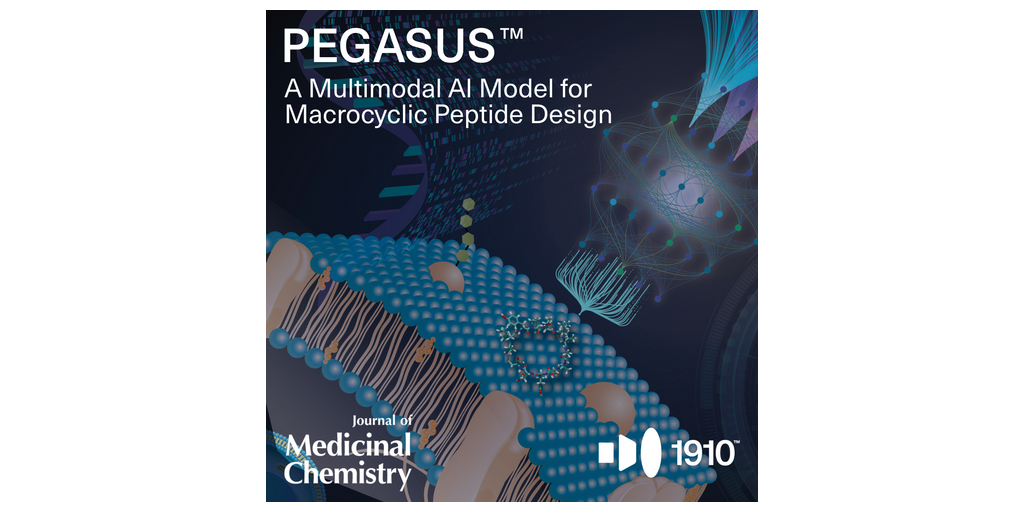



- PEGASUS™ is an industry-first in peptide design: It achieves AI-driven generative design of the first permeable macrocyclic peptide with more than two polar or ionizable fragments.
- Surrogate assays are a breakthrough for AI model training. 1910 developed a high throughput surrogate wet lab assay that replaces the industry standard low-throughput biological assay for training PEGASUS™.
- PEGASUS™ was published as a Featured Article in the Journal of Medicinal Chemistry based on its exceptional novelty and significant scientific merit, and was hailed as a breakthrough innovation in peptide design by practitioners who are typically skeptical of AI.
BOSTON: 1910, the only AI-native biotech pioneering small and large molecule therapeutics discovery, today announced the publication of PEGASUS™, a multimodal AI model that achieves state-of-the-art accuracy in predicting and designing cell-permeable macrocyclic peptides.
As featured in the Journal of Medicinal Chemistry, PEGASUS™ generated the first reported macrocyclic peptides containing more than two polar or charged fragments that demonstrate in vitro cell permeability, addressing a longstanding barrier in peptide drug design. The publication, titled “PEGASUS: Unlocking Polarity in Cell-Permeable Cyclic Peptides Using AI Models Built on Massively Parallel Biological Assays,” is available here.
Macrocyclic peptides are a promising therapeutic class with the potential for oral bioavailability and intracellular activity, yet efforts to design them have been constrained by the intrinsic difficulty of achieving cell permeability. And although AI could help overcome this barrier, progress has been limited by a lack of permeability data: existing datasets are scarce, sparse, and biased toward hydrophobic peptides, limiting the ability of AI models to generalize beyond a narrow chemical space.
PEGASUS™ overcomes these challenges by integrating three data modalities:
- Wet-lab proxy biological data generated through 1910’s high-throughput Permeability Proxy Assay (1910 PPA™), which fractionated 2.7 billion macrocyclic peptides by hydrophobicity;
- Computational simulation data from solvent-dependent quantum mechanical models; and
- Geometric and biological embeddings that learn structural features relevant to permeability.
These combined datasets enable PEGASUS™ to learn permeability-relevant features across the full landscape of macrocyclic peptide chemistry, including regions with high polarity and charge that have historically been inaccessible to rational design. Access to this space is critical: limiting designs to low-polarity, hydrophobic peptides both increases the risk of off-target binding and in vivo toxicity, and shrinks the number of allowable peptide sequences by 96.7%, excluding peptide structures that more closely resemble existing FDA-approved therapeutics.
“In drug discovery, AI has always been constrained by the lack of large, high-quality biological datasets,” said Jen Asher, Ph.D., Founder and CEO of 1910. “PEGASUS™ closes that gap. By generating billions of experimental data points and integrating them with physics-based simulations, we built a model that expands the therapeutic possibilities for macrocyclic peptides.”
In retrospective validation, the PEGASUS™ predictive framework improved hit rates by 13.1% when used as a pre-synthesis filter, outperforming existing deep learning approaches. The integrated generative component (CycPepVAE) produced 33 macrocyclic peptides that resemble FDA-approved therapeutics in polarity and charge; among those synthesized and tested, four achieved permeability consistent with in vivo oral bioavailability – a first for peptides in this chemical regime.
“Cell permeability is essential for oral drug delivery, yet there remains limited chemical overlap between macrocyclic peptides that are routinely designed to be permeable and those that have achieved clinical success,” said Cole Baker, AI Research Scientist II at 1910 and lead author of the publication. “Our work helps bridge this gap to enable the design of orally bioavailable macrocyclic peptide therapeutics.”
Developed within 1910’s ITO™ platform, PEGASUS™ functions both as a high-accuracy predictor of permeability for large, polar macrocyclic peptides and as a generative system that designs drug-like peptide candidates with improved solubility, polarity, and charge characteristics.
The publication establishes PEGASUS™ as the most comprehensive AI system for macrocyclic peptide permeability to date and provides a blueprint for using multimodal data integration to advance new therapeutic modalities.
About 1910
1910 is the only AI-native biotech pioneering small and large molecule therapeutics discovery by integrating massive multimodal data, frontier AI models, and high-throughput lab automation into an infrastructure for AI-enabled drug discovery.
Fonte: Business Wire
Related news

Last News
RSA at Cybertech Europe 2024
Alaa Abdul Nabi, Vice President, Sales International at RSA presents the innovations the vendor brings to Cybertech as part of a passwordless vision for…
Italian Security Awards 2024: G11 Media honours the best of Italian cybersecurity
G11 Media's SecurityOpenLab magazine rewards excellence in cybersecurity: the best vendors based on user votes
How Austria is making its AI ecosystem grow
Always keeping an European perspective, Austria has developed a thriving AI ecosystem that now can attract talents and companies from other countries
Sparkle and Telsy test Quantum Key Distribution in practice
Successfully completing a Proof of Concept implementation in Athens, the two Italian companies prove that QKD can be easily implemented also in pre-existing…
Most read
Bentley Systems Announces Fourth Quarter and Full Year 2025 Results and…
Bentley Systems, Incorporated (Nasdaq: BSY), the infrastructure engineering software company, today announced results for the quarter ended December 31,…
Docebo Reports Fourth Quarter and Fiscal Year 2025 Results
Docebo Inc. (NASDAQ: DCBO; TSX:DCBO) (“Docebo” or the “Company”), a leading learning platform provider with a foundation in artificial intelligence (AI)…
NIQ Announces Strong Fourth Quarter and Full Year 2025 Results
NIQ Global Intelligence plc (NYSE: NIQ) (the “Company”, or “NIQ”), a leading global consumer intelligence company, today announced financial results for…
RingCentral to Present at Morgan Stanley Investor Conference
$rng #AI--RingCentral, Inc. (NYSE: RNG), a global leader in AI-powered business communications, today announced that members of its management team are…
G11 Media Networks
InnovationOpenLab is a channel of BitCity, a newspaper registered at the court of Como ,
n. 21/2007 del
11/10/2007- Registration ROC n. 15698
G11 MEDIA S.R.L.
Registered office Via NUOVA VALASSINA, 4 22046 MERONE (CO) - P.IVA/C.F.03062910132
Como business register n. 03062910132 - REA n. 293834 CAPITALE SOCIALE Euro 30.000 i.v.