
GLM-5 Launch Signals a New Era in AI: When Models Become Engineers
GLM-5, newly released as open source, signals a broader shift in artificial intelligence. Large language models are moving beyond generating code snippets or interface prototypes toward building compl...



SINGAPORE: GLM-5, newly released as open source, signals a broader shift in artificial intelligence. Large language models are moving beyond generating code snippets or interface prototypes toward building complete systems and carrying out complex, end-to-end tasks. The change marks a transition from so-called “vibe coding” to what researchers increasingly describe as agentic engineering.
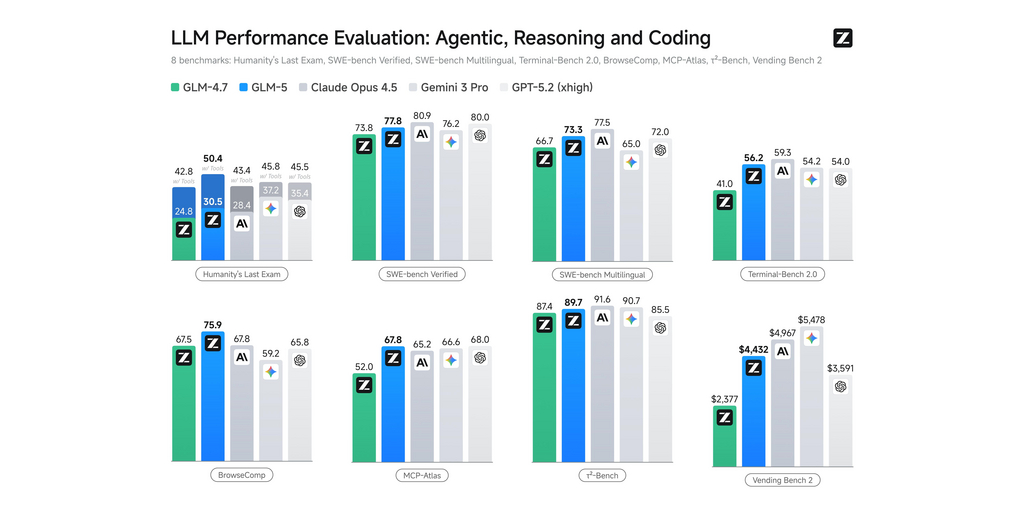
Built for this new phase, GLM-5 ranks among the strongest open-source models for coding and autonomous task execution. In practical programming settings, its performance approaches that of Claude Opus 4.5, particularly in complex system design and long-horizon tasks requiring sustained planning and execution.
The model rests on a new architecture aimed at scaling both capability and efficiency. Its parameter count has expanded from 355bn to 744bn, with active parameters rising from 32bn to 40bn, while pre-training data has grown to 28.5trn tokens. These increases are paired with advances in training methods. A framework called Slime enables asynchronous reinforcement learning at a larger scale, allowing the model to learn continuously from extended interactions and improve post-training efficiency. GLM-5 also introduces DeepSeek Sparse Attention, which maintains long-context performance while cutting deployment costs and improving token efficiency.
Benchmarks suggest strong gains. On SWE-bench-Verified and Terminal Bench 2.0, GLM-5 scores 77.8 and 56.2, respectively, the highest reported results for open-source models, surpassing Gemini 3 Pro in several software-engineering tasks. On Vending Bench 2, which simulates running a vending-machine business over a year, it finishes with a balance of $4,432, leading other open-source models in operational and economic management.
These results highlight the qualities required for agentic engineering: maintaining goals across long horizons, managing resources, and coordinating multi-step processes. As models increasingly assume these capabilities, the frontier of AI appears to be shifting from writing code to delivering functioning systems.
Chat & Official API Access
Z.ai Chat: https://chat.z.ai
GLM Coding Plan: https://z.ai/subscribe
Open-Source Repositories
GitHub: https://github.com/zai-org/GLM-5
Hugging Face: https://huggingface.co/zai-org/GLM-5
Blog
GLM-5 Technical Blog: https://z.ai/blog/glm-5
Fonte: Business Wire
Related news

Last News
RSA at Cybertech Europe 2024
Alaa Abdul Nabi, Vice President, Sales International at RSA presents the innovations the vendor brings to Cybertech as part of a passwordless vision for…
Italian Security Awards 2024: G11 Media honours the best of Italian cybersecurity
G11 Media's SecurityOpenLab magazine rewards excellence in cybersecurity: the best vendors based on user votes
How Austria is making its AI ecosystem grow
Always keeping an European perspective, Austria has developed a thriving AI ecosystem that now can attract talents and companies from other countries
Sparkle and Telsy test Quantum Key Distribution in practice
Successfully completing a Proof of Concept implementation in Athens, the two Italian companies prove that QKD can be easily implemented also in pre-existing…
Most read
BostonGene RNA Transcriptome Profiling Reveals New ADC Targets in Advanced…
BostonGene, developer of the leading AI foundation model for tumor and immune biology, announced results from the FEASY study in collaboration with The…
News Media Alert: Absolute Security Congratulates Inaugural Resilient…
#absolutesecurity--(RSAC) Absolute Security, an enterprise cyber resilience leader, today announced the first honorees for the inaugural Resilient CISO…
Palantir Technologies Announces the Renewal and Expansion of Its Partnership…
Palantir Technologies Inc. (NASDAQ: PLTR) today announced the renewal and expansion of its long‑standing partnership with Stellantis. The new five‑year…
Soluna Reports Record 2025 Growth: Pipeline Hits 4.3GW, Raises $142 Million,…
$SLNH #SLNH--Soluna Holdings, Inc. (“Soluna Holdings” or the “Company”) (NASDAQ: SLNH), a developer of green data centers for intensive computing applications,…
G11 Media Networks

InnovationOpenLab is a channel of BitCity, a newspaper registered at the court of Como ,
n. 21/2007 del
11/10/2007- Registration ROC n. 15698
G11 MEDIA S.R.L.
Registered office Via NUOVA VALASSINA, 4 22046 MERONE (CO) - P.IVA/C.F.03062910132
Como business register n. 03062910132 - REA n. 293834 CAPITALE SOCIALE Euro 30.000 i.v.