
AI: The New Insider Threat Facing Organizations
According to the Thales 2026 Data Threat Report, organizations across various markets including automotive, energy, finance and retail say the rapid pace of AI-driven transformation is now their bigge...
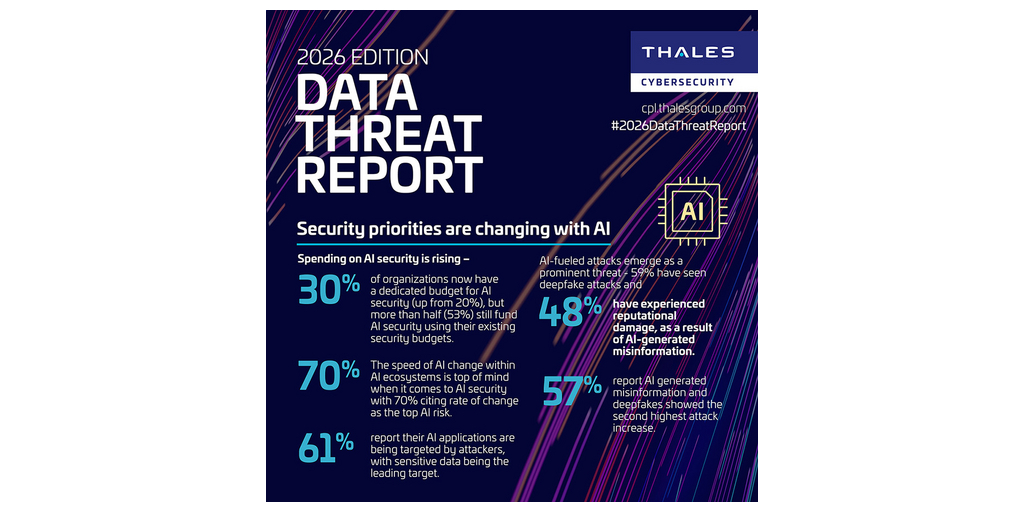



Thales 2026 Data Threat Report Finds 70% of Organizations Rank AI as Top Data Security Risk
- As AI systems gain broader access to enterprise data across environments, organizations must treat data visibility and encryption as core security elements.
/li> - AI-enabled deepfakes and misinformation are increasing the effectiveness of identity-based attacks. Today, credential theft is the leading attack technique against cloud infrastructure (67%). Nearly 60% of companies report deepfake-driven incidents, and 48% experience damage from AI-generated misinformation
/li> - Investment in AI security is growing, with 30% of companies allocating dedicated budgets; however, 53% are still relying on existing security budget
MEUDON, France: According to the Thales 2026 Data Threat Report, organizations across various markets including automotive, energy, finance and retail say the rapid pace of AI-driven transformation is now their biggest security challenge. Based on the report’s research, conducted by S&P Global 451 Research, 61% cite AI as their top data security risk. The concern is not only about malicious AI, but about the access it is being granted as it shifts from a tool to a trusted insider.
As enterprises embed AI into workflows, analytics, customer service, and development pipelines, these systems are being granted broad, automated access to enterprise data, often with fewer controls than those applied to human users in a corporate environment.
“Insider risk is no longer just about people. It is also about automated systems that have been trusted too quickly,” says Sebastien Cano, Senior Vice President, Cybersecurity Products at Thales. “When identity governance, access policies, or encryption are weak, AI can amplify those weaknesses across corporate environments far faster than any human ever could.”
Visibility Gaps Are Widening as AI Expands Data Reach
The report reveals a troubling disconnect between AI adoption and data control. Only 34% of organizations know where all their data resides, whatever the level of criticality, and just 39% can fully classify it. Meanwhile, nearly half (47%) of sensitive cloud data remains unencrypted.
As AI systems ingest and act on data across cloud and SaaS environments, limited visibility makes enforcing least-privilege access increasingly difficult, that is granting only the strictly necessary access rights. This increases the extent of exposure if credentials are compromised.
Identity infrastructure is now the primary attack surface. Credential theft remains the leading attack technique against cloud management infrastructure, cited by 67% of organizations experiencing cloud attacks. At the same time, 50% rank secrets management among their top application security challenges, reflecting the growing complexity of governing machine identities, API (interfaces de programmation applicative) keys, and tokens at scale.
AI Is Powering More Convincing Attacks
While organizations race to adopt AI, attackers are doing the same. Nearly 60% of companies report experiencing deepfake-driven attacks, and 48% report reputational damage tied to AI-generated misinformation or impersonation campaigns.
As AI introduces new risks, it also increases existing ones. Human error already contributes to 28% of breaches, and with automation layered on top, small mistakes can scale faster and spread wider.
Security Investment Is Shifting, But Not at the Pace of the new Risks
While organizations recognize the need to adapt, investment is not keeping pace with the rapid expansion of AI-driven access and automation. 30% now dedicate specific budgets to AI security, reflecting growing awareness. However, the majority (53%) still depend on traditional security programs built primarily for human users and perimeter-based controls. As machines increasingly authenticate, access, and act autonomously, many security strategies have yet to adjust to this shift in operating models.
“As AI becomes deeply embedded into enterprise operations, continuous data visibility and protection are no longer optional,” said Eric Hanselman, Chief Analyst at S&P Global 451 Research. “Organizations must treat data security strategy as foundational to innovation, not separate from it.”i
Trust Must Evolve as Machines Gain Access
AI is not replacing traditional threats; rather, it is intensifying them by increasing their speed, scale, and reach. As automated systems gain broader access to enterprise data, organizations must rethink identity, encryption, and data visibility as core infrastructure. The organizations that embed strong governance into their AI strategies will be better positioned to innovate securely and avoid turning AI into their newest insider threat.
For more information, please download the full report and join our webinar hosted by Eric Hanselman, Chief Analyst at S&P Global 451 Research.
About Thales
Thales (Euronext Paris: HO) is a global leader in advanced technologies for the Defence, Aerospace, and Cyber & Digital sectors. Its portfolio of innovative products and services addresses several major challenges: sovereignty, security, sustainability and inclusion.
The Group invests more than €4 billion per year in Research & Development in key areas, particularly for critical environments, such as Artificial Intelligence, cybersecurity, quantum and cloud technologies.
Thales has more than 83,000 employees in 68 countries. In 2024, the Group generated sales of €20.6 billion.
| |
i Thales 2026 Data Threat Report, 2026, commissioned by Thales and conducted by S&P Global 451 Research | |
Fonte: Business Wire
Related news

Last News
RSA at Cybertech Europe 2024
Alaa Abdul Nabi, Vice President, Sales International at RSA presents the innovations the vendor brings to Cybertech as part of a passwordless vision for…
Italian Security Awards 2024: G11 Media honours the best of Italian cybersecurity
G11 Media's SecurityOpenLab magazine rewards excellence in cybersecurity: the best vendors based on user votes
How Austria is making its AI ecosystem grow
Always keeping an European perspective, Austria has developed a thriving AI ecosystem that now can attract talents and companies from other countries
Sparkle and Telsy test Quantum Key Distribution in practice
Successfully completing a Proof of Concept implementation in Athens, the two Italian companies prove that QKD can be easily implemented also in pre-existing…
Most read
Roblox Announces Roblox Plus, a New Subscription Plan Offering Exclusive…
Roblox (NYSE: RBLX) today announced Roblox Plus, a new subscription plan designed to deliver more value to its users. Available globally starting April…
Energy Vault Enters Japanese Market with Acquisition of 850 MW Energy…
$NRGV--Energy Vault Holdings, Inc. (NYSE: NRGV) (“Energy Vault” or the “Company”), a global leader in sustainable, grid-scale energy storage and AI compute…
SS&C to Release First Quarter 2026 Earnings
SS&C Technologies Holdings, Inc. (Nasdaq: SSNC), a global provider of services and software for the financial services and healthcare industries,…
Western Union to Release First Quarter 2026 Results on April 24, 2026
The Western Union Company (NYSE: WU) announced today that Chief Executive Officer, Devin McGranahan, and Chief Financial Officer, Matt Cagwin, will host…
G11 Media Networks

InnovationOpenLab is a channel of BitCity, a newspaper registered at the court of Como ,
n. 21/2007 del
11/10/2007- Registration ROC n. 15698
G11 MEDIA S.R.L.
Registered office Via NUOVA VALASSINA, 4 22046 MERONE (CO) - P.IVA/C.F.03062910132
Como business register n. 03062910132 - REA n. 293834 CAPITALE SOCIALE Euro 30.000 i.v.