
MAX Finds 35% of Gen Zers Would Stop Liking a Song After Learning It Was Created by AI
#artificialintelligence--More than a third of Gen Z say they would stop liking a song they enjoy if they found out it was made by AI. It’s not a one-off finding. According to “The Fractured Future...
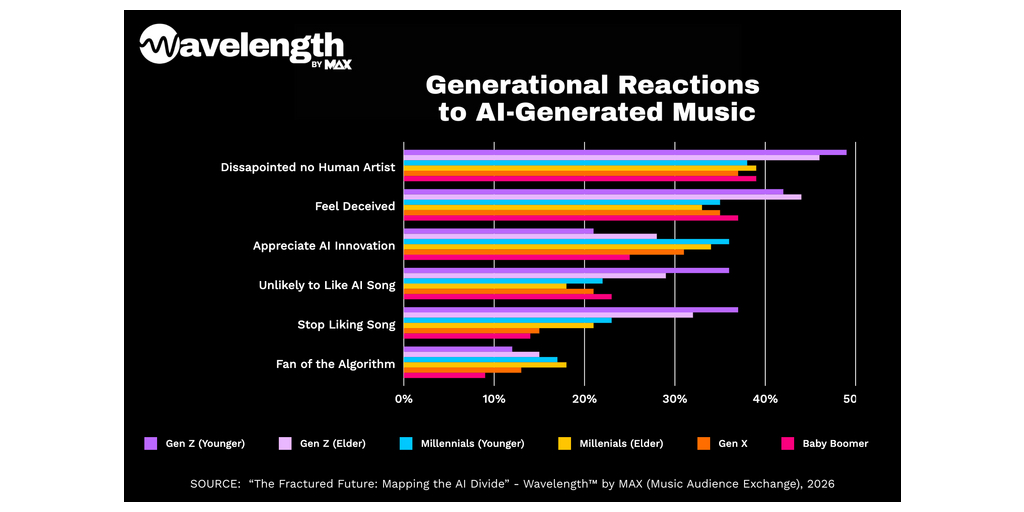



New 14,000-person study from Wavelength™ by MAX finds the generation that uses AI the most is also its harshest critic, especially when it comes to music
DALLAS: #artificialintelligence--More than a third of Gen Z say they would stop liking a song they enjoy if they found out it was made by AI. It’s not a one-off finding. According to “The Fractured Future: Mapping the AI Divide,” a new report from Wavelength™ by MAX (Music Audience Exchange), the generation that uses AI the most is also the most hostile to its impact. That hostility doesn’t stop at survey questions about trust or regulation; it reaches the music on their playlists. Across the full study, AI attitudes fracture along lines that most surveys miss: income, race, genre culture, and gender.
The Gen Z Conundrum
Gen Z leads all generations in AI usage (81%), but they also express the most negative sentiment toward the technology. Unlike Millennials, who believe AI will improve their own lives even as they worry about its societal impact, Gen Z does not carve out that personal exception. Younger Gen Z respondents don’t think AI will make their lives better, even though they use it more than any other group. The negativity is sharpest among Gen Z women, who express the most pessimistic outlook of any demographic segment in the study.
“The same college student who uses AI to do their assignments may refuse to buy your product featuring AI creative. There’s a hostility to AI among Gen Z that is as much about their romanticizing of an analog world as it is their fears of an AI-first world.” –Jeff Rosenfeld, Chief Product Officer at MAX.
Within Gen Z, race also shapes the picture: White Gen Z respondents hold the most negative views, while Black Gen Z respondents are more optimistic about AI's potential, a pattern that echoes across every generation in the study. Gen Z's resistance is often rooted in moral concerns, including the environmental impact of AI. In contrast, Millennial and Gen X holdouts generally cite a lack of practical need or uncertainty about how to get started.
Fragmenting Search Landscape
How people use AI and how they find information varies significantly by generation. Among the youngest Gen Z AI users, nearly 70% use the technology for work or schoolwork, making it primarily a productivity tool. Among Baby Boomer AI users, two-thirds use it as a search engine alternative and fewer than 17% use it for work, effectively treating AI as a glorified search bar.
For Gen Z, information discovery is more likely to come from social media than AI. In fact, Gen Z women are far more likely to turn to social media (like Reels and TikTok creators) for answers than AI (65% vs. 32%). Men across all age groups use AI for search at higher rates than women, but even among Gen Z men, social media outpaces AI as a discovery tool.
AI and Music: Interest is Cultural (and complicated)
When asked how they would react to discovering a song they like was AI-generated, the most common response across all ages was disappointment that there was no human artist and a feeling of having been deceived. But the willingness to act on that feeling is generational: more than a third of Gen Z say they would stop liking the song entirely, compared to just 15% of Gen X and Baby Boomers.
When it comes to creating music with AI, genre culture may matter more than age. Fans of regional Latin genres like Salsa, Banda, and Cumbia expressed the strongest interest in using AI to make music, while fans of genres where the identity of the individual creator is central to the art form, such as Folk and Indie, were the most resistant. Demographics also play a role: Millennial and Black music fans expressed the most interest in generating music with AI; Gen Z and White music fans were the most hostile.
The Wavelength report is based on a survey of more than 14,000 nationally representative consumers (ages 13-64) balanced across age, gender, ethnicity, and income, with an emphasis on using music taste as a behavioral predictor.
The full AI report is available for free at Wavelength.MAX.Live in an interactive, web-based format and a downloadable version, with presentation-ready graphics.
About MAX (Music Audience Exchange):
MAX gives brands direct access to artists’ story, stage, and social footprint. Grounded in the company’s proprietary Artist Matching Engine, MAX is backed by tech VCs and built by a team of data scientists, engineers, music pros, and media experts. MAX powers partnerships for top brands (like Ford, Rocket Mortgage, McDonald’s, AARP, US Marine Corps, and more) and supports a growing portfolio of 6,000+ artists (including Alicia Keys, Kane Brown, Jon Batiste, Eslabon Armado, Leela James, Lalah Hathaway, Justin Quiles, AJR, and Melissa Etheridge) with live engagement tools and promotional sponsorships.
Fonte: Business Wire
Related news

Last News
RSA at Cybertech Europe 2024
Alaa Abdul Nabi, Vice President, Sales International at RSA presents the innovations the vendor brings to Cybertech as part of a passwordless vision for…
Italian Security Awards 2024: G11 Media honours the best of Italian cybersecurity
G11 Media's SecurityOpenLab magazine rewards excellence in cybersecurity: the best vendors based on user votes
How Austria is making its AI ecosystem grow
Always keeping an European perspective, Austria has developed a thriving AI ecosystem that now can attract talents and companies from other countries
Sparkle and Telsy test Quantum Key Distribution in practice
Successfully completing a Proof of Concept implementation in Athens, the two Italian companies prove that QKD can be easily implemented also in pre-existing…
Most read
Zayo Issues $2.37 Billion of Asset-Backed Term Notes
Zayo, a leading digital infrastructure provider, today announced it has closed on the issuance of $2.37 billion of asset-backed term notes (the “Notes”),…
NCR Atleos Announces Date of First Quarter 2026 Earnings Results
NCR Atleos Corporation (NYSE: NATL) (“Atleos”) will release first quarter 2026 financial results after the market close on Wednesday, May 6, 2026. Due…
Orkes Raises $60M as Developers Increasingly Use Its Platform to Deploy…
Orkes, the agents and durable workflow orchestration platform built by the original architects of Netflix's microservices orchestration platform, has…
Hitachi Digital Services Announces Strategic Partnership with Stripe to…
#AI--Hitachi Digital Services, the global systems integrator powering mission-critical platforms, today announced a strategic partnership with Stripe,…
G11 Media Networks

InnovationOpenLab is a channel of BitCity, a newspaper registered at the court of Como ,
n. 21/2007 del
11/10/2007- Registration ROC n. 15698
G11 MEDIA S.R.L.
Registered office Via NUOVA VALASSINA, 4 22046 MERONE (CO) - P.IVA/C.F.03062910132
Como business register n. 03062910132 - REA n. 293834 CAPITALE SOCIALE Euro 30.000 i.v.