
Toshiba’s Breakthrough Algorithm Harnesses Edge of Chaos to Dramatically Boost Performance of its Quantum‑Inspired Computer
#SBM--Toshiba Corporation has developed a breakthrough algorithm that dramatically boosts the performance of the Simulated Bifurcation Machine (SBM), its proprietary quantum‑inspired combinatorial o...



~Approximately 100 times faster, will accelerate solutions for drug discovery, finance, and other complex problems~
KAWASAKI, Japan: #SBM--Toshiba Corporation has developed a breakthrough algorithm that dramatically boosts the performance of the Simulated Bifurcation Machine (SBM), its proprietary quantum‑inspired combinatorial optimization computer. The new algorithm significantly improves the probability of obtaining an optimal solution or a known best solution within a limited number of trials-referred to as the success probability, a key benchmark for evaluating combinatorial optimization technologies.
The SBM is designed to solve large‑scale combinatorial optimization problems in a wide range of fields, including new drug discovery, delivery route optimization, and investment portfolio design. While previous algorithms could find optimal or known best solutions with a sufficiently large number of trials, large‑scale problems often trapped the search process in local optima, significantly lowering success probability under practical constraints that limit the number of trials.
Toshiba has overcome this challenge by developing a third‑generation simulated bifurcation (SB) algorithm. This ground-breaking advance builds on the original SB algorithm, announced in April 2019*1, and the second‑generation SB algorithm, released in February 2021*2, which delivered major boosts to computational speed and accuracy.
The new algorithm expands the bifurcation parameter that triggers the bifurcation phenomena*3-a defining feature of the SB algorithm-from a single global parameter to individual parameters assigned to each position variable*4. These bifurcation parameters are independently controlled according to the values of the corresponding position variables, enabling a more adaptive and effective solution search.
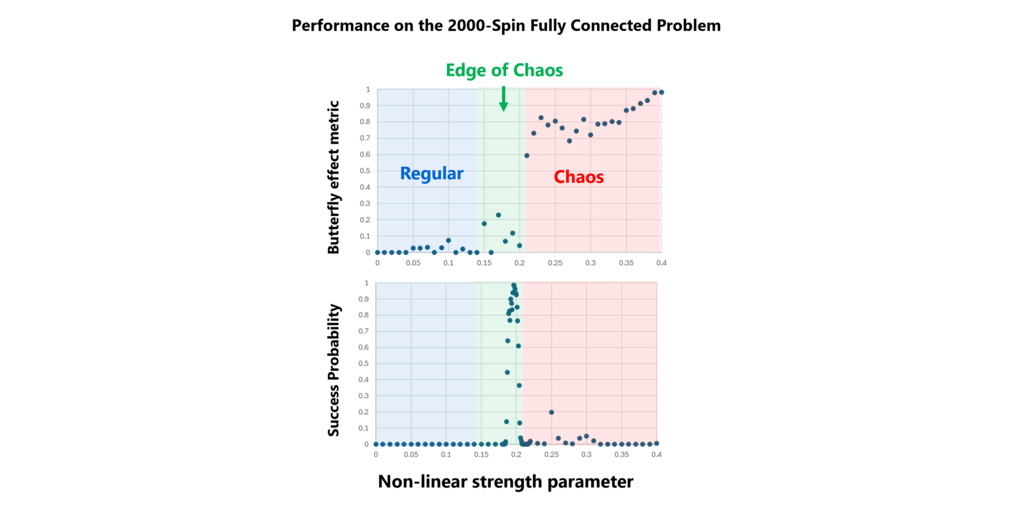
With the introduction of this advanced control mechanism, the algorithm exhibits either regular or chaotic behavior*5, depending on conditions. Crucially, Toshiba discovered that by effectively harnessing chaos at the edge of chaos-the boundary between regular dynamics and chaotic motion-the algorithm can escape local optima far more efficiently. As a result, the success probability of reaching the global optimum increases dramatically, approaching 100%.
The SBM based on the new algorithm is therefore much faster. It delivers a time to solution (TTS) required to obtain an optimal or known best solution that is approximately 100 times faster than the SBM based on the second‑generation algorithm. These advances are expected to accelerate the practical applications of combinatorial optimization across a broad range of challenges.
The research results were published in the April 6, 2026 issue of Physical Review Applied, a peer‑reviewed journal of the American Physical Society*6.
Note:
*1 https://advances.sciencemag.org/content/5/4/eaav2372
*2 https://advances.sciencemag.org/content/7/6/eabe7953
*3 In nonlinear dynamical systems, a phenomenon in which changes in system parameters (bifurcation parameters) cause the number of stable points to change from one to multiple.
*4 In the SB algorithm, the equations of motion of a classical dynamical system consisting of many oscillators are solved. A position variable represents the position of each oscillator, and these position variables correspond to the decision variables (discrete variables) of the combinatorial optimization problem.
*5 In nonlinear dynamical systems, a phenomenon in which even slight differences in initial conditions cause the subsequent trajectories of motion to diverge significantly, resulting in disordered (chaotic) behavior. This sensitivity of chaos to initial conditions is known as the butterfly effect, and the upper panel of Figure 1 provides a quantitative evaluation of this effect.
*6 https://doi.org/10.1103/2qd9-x6v8
About Toshiba
For over 150 years, guided by its corporate philosophy, “Committed to People, Committed to the Future.,” Toshiba Group has contributed to society through its business activities. Today, the Group continues to enhance its management structure, streamline operations, and invest in forward‑looking businesses in the energy, digital infrastructure, and electronic devices domains.
Annual sales in fiscal year 2025 were 3.5 trillion yen, with 95,000 employees worldwide. Find out more on our website or follow us on LinkedIn.
Fonte: Business Wire
Related news

Last News
RSA at Cybertech Europe 2024
Alaa Abdul Nabi, Vice President, Sales International at RSA presents the innovations the vendor brings to Cybertech as part of a passwordless vision for…
Italian Security Awards 2024: G11 Media honours the best of Italian cybersecurity
G11 Media's SecurityOpenLab magazine rewards excellence in cybersecurity: the best vendors based on user votes
How Austria is making its AI ecosystem grow
Always keeping an European perspective, Austria has developed a thriving AI ecosystem that now can attract talents and companies from other countries
Sparkle and Telsy test Quantum Key Distribution in practice
Successfully completing a Proof of Concept implementation in Athens, the two Italian companies prove that QKD can be easily implemented also in pre-existing…
Most read
BostonGene RNA Transcriptome Profiling Reveals New ADC Targets in Advanced…
BostonGene, developer of the leading AI foundation model for tumor and immune biology, announced results from the FEASY study in collaboration with The…
Enterprises Align AI and Data Platforms to Scale AI Deployments with Accuracy,…
$III #AI--Enterprises are coordinating AI and data programs and adopting platforms that address both as they deploy AI for functions that require data…
Wing Venture Capital Releases Eighth Annual ‘Enterprise Tech 30’ List,…
The eighth annual Enterprise Tech 30, a list of the most promising private companies across the enterprise technology spectrum, was announced today by…
ServiceNow to Announce First Quarter 2026 Financial Results on April 22
ServiceNow (NYSE: NOW) today announced that it will release financial results for the first quarter ended March 31, 2026, following the close of market…
G11 Media Networks

InnovationOpenLab is a channel of BitCity, a newspaper registered at the court of Como ,
n. 21/2007 del
11/10/2007- Registration ROC n. 15698
G11 MEDIA S.R.L.
Registered office Via NUOVA VALASSINA, 4 22046 MERONE (CO) - P.IVA/C.F.03062910132
Como business register n. 03062910132 - REA n. 293834 CAPITALE SOCIALE Euro 30.000 i.v.