Muse Completes “Sleep, by Design” Platform with Smart Wakeup: A Smarter Alarm That Wakes Your Brain Up at the Right Time
#brainhealth--Muse by Interaxon today announced Smart Wakeup, the newest addition to its Sleep, by Design platform. Smart Wakeup monitors brain activity in real time and times a gentle audio wake-up t...
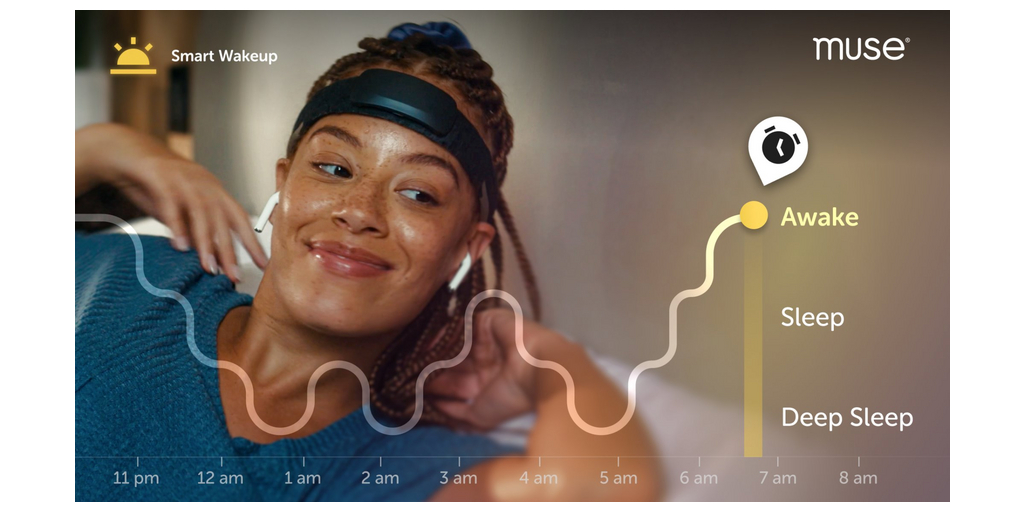



Smart Wakeup uses real-time brainwave monitoring to find the lightest moment in your sleep cycle before gently waking you.
An internal study of 6,200 nights shows why wake timing matters and who benefits most.
TORONTO: #brainhealth--Muse by Interaxon today announced Smart Wakeup, the newest addition to its Sleep, by Design platform. Smart Wakeup monitors brain activity in real time and times a gentle audio wake-up to lighter sleep, so the alarm works with your brain, not against it.
Sleep Assist helps users fall asleep. Deep Sleep Boost strengthens the deepest, most restorative stage of the night. Smart Wakeup completes the arc: a brain-aware alarm that protects the sleep you’ve built rather than shattering it at the finish line.
What 6,200 Nights of Brain Data Told Us
Smart Wakeup was built on data. An internal analysis of approximately 6,200 nights from roughly 1,300 Muse users, each tracked with detailed brainwave analysis across every sleep stage and paired with morning mood ratings.1
The biggest factor in morning mood? Sleep duration - by a wide margin. But among users who already slept well (seven-plus hours, high efficiency-about 26% of nights), waking during lighter sleep was associated with a noticeably better morning mood than waking from deeper stages.2 When sleep needs are met, the transition out of sleep becomes the next factor you can actually improve. Light sleep is the brain’s natural exit ramp and catching that window means a clearer morning.
Smart Wakeup won’t rescue a bad night, but for people who sleep well, it delivers a measurable improvement by timing the alarm to the brain’s readiest moment. Sleep better, then wake smarter.
Why Your Alarm Hits a Different Brain Every Morning
Your brain doesn’t cycle through sleep stages at the same clock time every night. Muse’s data shows that REM-rich periods-which dominate the final hours of sleep-drift from night to night, shifting with travel, schedule changes, and your body’s own internal clock.3 A 7:00 AM alarm that catches light sleep on Monday might pull you out of deep sleep on Friday. That matters because sleep inertia-the grogginess that follows an abrupt awakening-is significantly worse when you’re pulled out of deep sleep.4
How Smart Wakeup Works
You set a wake window, 30 to 60 minutes, and a latest wake time. During that window, Muse reads your brain activity in real time and starts a gentle, gradual audio rise the moment it detects lighter sleep. If no lighter-sleep window appears, the system wakes you by your set time.
“There’s a moment every morning that nobody’s ever had control over-when the alarm fires and your brain gets pulled out of whatever stage it’s in. Smart Wakeup gives you control over that moment for the first time.” - Nadia Kumentas, Chief Marketing Officer, Muse
Why Muse Is Different
Most smart alarms estimate sleep stage from motion or heart rate. Muse reads brain activity directly using EEG, the same type of measurement used in hospital sleep labs.5 When the entire point of a smart alarm is acting on the right sleep stage at the right moment, the difference between measuring brain activity and estimating it from wrist movement is not incremental. It’s foundational.
What’s Next
Smart Wakeup launches today with its core brain-guided wake window. Planned 2026 expansions include:
- Sleep Goal Wake: waking once a personal recovery target is met
- Dream Retention Mode: timing wake-ups to REM for dream recall, and
- Hypnopompic Audio: layering guided content into the transition from sleep to wakefulness-using the brain’s most receptive morning moment intentionally.
Availability
Starting April 15, 2026, Smart Wakeup requires a Muse Premium subscription and is compatible with Muse S (Gen 1), Muse S (Gen 2), and Muse S Athena on iOS and Android. Deep Sleep Boost and Sleep Assist are included free with every Muse S device.
About Muse by Interaxon Inc.
Muse is a brain health platform built on the world’s largest consumer brain wave dataset-over 1 billion minutes decoded to date. Muse’s AI-driven tools support sleep, focus, and stress management for consumers, while powering more than 200 third-party-led studies from institutions including the Mayo Clinic, MIT, and Harvard. Muse S Athena, featuring combined EEG and fNIRS sensors, is the company’s most advanced device. Headquartered in Toronto, Canada.
Learn more: choosemuse.com
1Internal analysis of ~6,444 nights from ~1,300 Muse headband users with epoch-by-epoch EEG sleep staging and self-reported morning mood (5-point scale). |
Fonte: Business Wire
Related news

Last News
RSA at Cybertech Europe 2024
Alaa Abdul Nabi, Vice President, Sales International at RSA presents the innovations the vendor brings to Cybertech as part of a passwordless vision for…
Italian Security Awards 2024: G11 Media honours the best of Italian cybersecurity
G11 Media's SecurityOpenLab magazine rewards excellence in cybersecurity: the best vendors based on user votes
How Austria is making its AI ecosystem grow
Always keeping an European perspective, Austria has developed a thriving AI ecosystem that now can attract talents and companies from other countries
Sparkle and Telsy test Quantum Key Distribution in practice
Successfully completing a Proof of Concept implementation in Athens, the two Italian companies prove that QKD can be easily implemented also in pre-existing…
Most read
Enterprises Align AI and Data Platforms to Scale AI Deployments with Accuracy,…
$III #AI--Enterprises are coordinating AI and data programs and adopting platforms that address both as they deploy AI for functions that require data…
Moonbounce Launches with $12M to Give Organizations Real-Time Control…
Moonbounce, the AI control engine that ensures systems behave exactly as designed at any scale, today launched with $12 million in funding. Lead investors…
ServiceNow to Announce First Quarter 2026 Financial Results on April 22
ServiceNow (NYSE: NOW) today announced that it will release financial results for the first quarter ended March 31, 2026, following the close of market…
Highflame and Tailscale Partner to Secure AI Agents and Model & MCP Interactions…
AI agents now generate thousands of LLM requests across developer machines, CI pipelines, and internal systems. Each request can carry prompts, tool calls,…
G11 Media Networks

InnovationOpenLab is a channel of BitCity, a newspaper registered at the court of Como ,
n. 21/2007 del
11/10/2007- Registration ROC n. 15698
G11 MEDIA S.R.L.
Registered office Via NUOVA VALASSINA, 4 22046 MERONE (CO) - P.IVA/C.F.03062910132
Como business register n. 03062910132 - REA n. 293834 CAPITALE SOCIALE Euro 30.000 i.v.