
Optimal Transit Unveils Second Configuration of the Kraaken™ Data Center: A Ship That Can Power 32,000 Homes, Produce Clean Water for 150,000 People, and Host 60 MW of AI Compute – With No Fuel and No Emissions
Optimal Transit, the maritime technology partnership of InMar Technologies and OptiFuel Systems, today announced the Blue Economy VITAL 100 MW Kraaken™ – a second configuration of its Kraaken™ p...
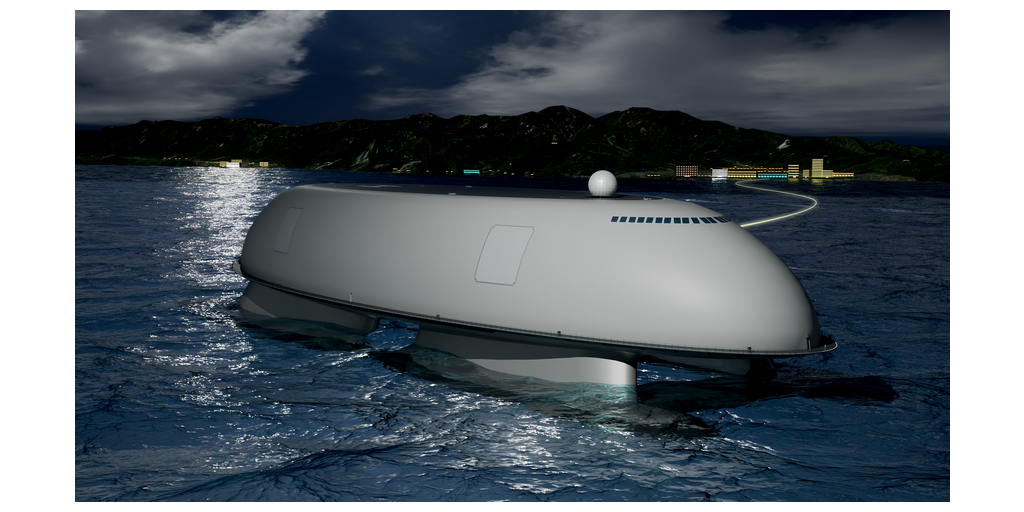



BEAUFORT, S.C.: Optimal Transit, the maritime technology partnership of InMar Technologies and OptiFuel Systems, today announced the Blue Economy VITAL 100 MW Kraaken™ – a second configuration of its Kraaken™ platform that redirects a portion of the vessel's total power capacity away from data center operations and toward direct utility service: baseload electricity and fresh water, exported continuously to shore.
The announcement builds on Optimal Transit’s July 7 unveiling of the Kraaken™ as a self-powered maritime AI data center, demonstrating how the same platform can address a broader range of critical infrastructure needs. The VITAL 100 MW configuration retains the same proven small waterplane area twin hull (SWATH) architecture – with its exceptional stability and flexible mooring system – as well as the patented Digital Ocean Thermal (DOT) self-powering engine and commercial off-the-shelf components with long operating histories in demanding industrial and maritime environments. What changes is how the vessel’s output is allocated: a greater share is directed toward delivering continuous baseload electricity and fresh water to shore, while substantial capacity remains available for secure AI and data center operations.
“When we introduced the Kraaken™ as a data center platform, we presented a self-powered, zero emission vessel designed to dedicate its full capacity to compute,” said Jeff Kline, President of InMar Technologies. "The VITAL 100 MW configuration takes the same core capabilities and asks a different question: what happens when you point some of that output directly at a coastline that doesn't have reliable power or clean water? The answer is a single vessel that can serve the equivalent of a small city – indefinitely, from offshore, with no connection to the existing grid."
One Hull. Multiple Configurations. Scalable to Any Mission.
The Kraaken™ platform is designed around a principle Optimal Transit calls mission-flexible architecture: the same standardized hull, self-powering engine technology, and mooring infrastructure can be configured to prioritize different outputs depending on the needs of the host project or government.
In its data center configuration, virtually all the vessel's net output powers hosted AI compute workloads. In the VITAL 100 MW configuration, the allocation shifts:
- Up to 40 MW of continuous clean baseload electricity is exported directly to shore – enough to reliably serve approximately 32,000 homes, 24 hours a day, 7 days a week, with zero fuel required.
- Approximately 30 million liters (roughly 7.9 million gallons) of fresh water per day are produced via vacuum-flash desalination – enough to support an estimated 150,000 people.
- 60 MW of remaining capacity for hosting AI-grade data center compute, for coastal city sovereign business and infrastructure needs.
All three outputs – power, water, and compute – flow to shore through a quick-disconnect umbilical system. If conditions require it, the vessel disconnects and relocates within hours. When conditions clear, it reconnects.
The Economics That Make It Viable
The VITAL 100 MW Kraaken™ vessel carries an all-in capital cost of approximately $587 million – a single integrated asset that generates its own power, produces its own fresh water, and hosts AI-grade data center capacity, with no land required, no fuel or grid connection needed, and no permitting fight to win.
To understand what that number actually means, it helps to price what it would cost to build the same capabilities on land. A comparably capable land-based bundle – a 40 MW power plant, a 7.9-million-gallon-per-day desalination facility, and a 60 MW AI-grade data center shell – would require three separate construction projects, three separate sites, and three separate permitting processes. The combined capital cost of those three projects runs from an estimated $750 million to $1.33 billion. And unlike a vessel that clears the shipyard ready to operate, each of those land-based projects faces a six-to-ten-year timeline to reach first revenue – grid interconnection queues, environmental permitting, and local zoning fights included.
The Kraaken™ delivers the same output bundle for roughly 44 to 78 percent of the land-based cost, from a single offshore mooring agreement, in approximately three years.
Once the vessel is in the water, the economics get even more interesting. In areas across sub-Saharan Africa, South and Southeast Asia, the Pacific Islands, and disaster-affected regions globally, a Kraaken™ vessel stands on its own as a utility investment before a single data center lease is signed. The cost of power in these markets is the cost of diesel self-generation: the generators that hospitals, industrial facilities, ports, and millions of households run as their primary or backup power source because the grid is too unreliable to depend on. In many of these markets, diesel self-generation costs approximately $0.40 to $0.55 per kilowatt-hour – three to four times the cost of grid power in developed markets.
A Disaster Relief Tool Unlike Anything Currently Available
Perhaps the most striking capability of the VITAL 100 MW Kraaken™ configuration is what it could mean for communities struck by natural or man-made disaster – the scenarios where power and clean water aren't an economic question, they're a survival question.
Consider what happened in Puerto Rico after Hurricane Maria struck in September 2017. The storm left all of Puerto Rico's 3.3 million residents without power and resulted in the longest blackout in U.S. history – approximately 11 months (U.S. GAO). In the six months following the hurricane, Puerto Ricans lost an estimated 3.9 billion hours of access to electric power, with rural communities accounting for 61 percent of that loss and some interior communities going without power for more than 120 days (NASA). More than 200,000 people ultimately left the island, many of them because of the protracted loss of electricity.
The VITAL 100 MW Kraaken™ would not have reversed the storm damage. But a vessel or two, pre-positioned or deployed within days of landfall, could have injected tens of megawatts of baseload power and millions of gallons of fresh water directly into Puerto Rico's coastal grid via umbilical – independent of the damaged terrestrial transmission infrastructure that made the recovery so slow and so catastrophic.
Mobility as a Risk Management Strategy
One of the most commercially significant features of the VITAL 100 MW Kraaken™ is also its most intuitive: unlike a power plant or desalination facility built on land, it can leave.
Each vessel connects to shore through a proven quick-disconnect mooring and umbilical system that has been in use in industrial maritime applications for more than 40 years. If a storm threatens, the vessel disconnects, repositions, and reconnects when conditions clear – without any interruption to the underlying asset's value. If political or regulatory conditions change, the vessel can be relocated to a different site or jurisdiction entirely. If the initial mission is completed – say, disaster relief for a storm-damaged island – the same vessel can be redeployed to the next project.
A Platform Designed to Scale
A single VITAL 100 MW Kraaken™ is designed to function as a standalone utility node. But Optimal Transit's architecture explicitly anticipates multi-vessel deployments. Five vessels co-located within a single two-mile offshore zone – a configuration the company calls a “Sovereign Power Park” – would deliver approximately 200 MW of baseload power, 40 million gallons of fresh water per day and 300MW of data center compute capacity. Requiring neither land nor fuel, this compact cluster of offshore assets could support infrastructure needs at the scale of a major metropolitan area, a national-grid segment, or a large industrial zone.
About Optimal Transit Optimal Transit is the maritime technology partnership of InMar Technologies and OptiFuel Systems, bringing together more than a century of combined experience in advanced naval architecture, autonomous systems, and energy engineering. Optimal Transit is an advanced systems engineering company that designs and builds autonomous maritime systems and self-powering engine technologies for commercial, government, and humanitarian applications. The company's platforms combine commercial off-the-shelf components with proprietary technologies and patented innovations developed by its founders across decades of U.S. defense, commercial, and maritime programs.
Learn more at www.OptimalTransit.com.
Fonte: Business Wire
Related news

Last News
RSA at Cybertech Europe 2024
Alaa Abdul Nabi, Vice President, Sales International at RSA presents the innovations the vendor brings to Cybertech as part of a passwordless vision for…
Italian Security Awards 2024: G11 Media honours the best of Italian cybersecurity
G11 Media's SecurityOpenLab magazine rewards excellence in cybersecurity: the best vendors based on user votes
How Austria is making its AI ecosystem grow
Always keeping an European perspective, Austria has developed a thriving AI ecosystem that now can attract talents and companies from other countries
Sparkle and Telsy test Quantum Key Distribution in practice
Successfully completing a Proof of Concept implementation in Athens, the two Italian companies prove that QKD can be easily implemented also in pre-existing…
Most read
Circle Reports Second Quarter 2026 Results
Circle Internet Group, Inc. (NYSE: CRCL) today announced results for the second quarter of fiscal year 2026. Financial Highlights (Q2’26 vs. Q2’25) USDC…
CORRECTING and REPLACING MVB Bank Selects Bretton AI to Run Its Back-Office…
Please replace the release dated August 6, 2026 with the following corrected version due to multiple revisions. The updated release reads: MVB BANK SELECTS…
Docebo Reports Second Quarter 2026 Results
Docebo Inc. (NASDAQ: DCBO; TSX:DCBO) (“Docebo” or the “Company”), the Enterprise Platform for the AI-era workforce, unifying skills intelligence, learning,…
Alibaba Group Will Announce June Quarter 2026 Results on August 20, 2026
Alibaba Group Holding Limited (NYSE: BABA and HKEX: 9988 (HKD Counter) and 89988 (RMB Counter), “Alibaba” or “Alibaba Group”) today announced that it…
G11 Media Networks

InnovationOpenLab is a channel of BitCity, a newspaper registered at the court of Como ,
n. 21/2007 del
11/10/2007- Registration ROC n. 15698
G11 MEDIA S.R.L.
Registered office Via NUOVA VALASSINA, 4 22046 MERONE (CO) - P.IVA/C.F.03062910132
Como business register n. 03062910132 - REA n. 293834 CAPITALE SOCIALE Euro 30.000 i.v.