
"Resigned Consent": New Global Study Finds Consumers Grant AI Access Reluctantly More Than Twice as Often as Willingly
Nearly six in ten consumers are uncomfortable letting an AI assistant access their data. Most of them say yes anyway, and new global research shows a large share of that "yes" is based on resignation,...
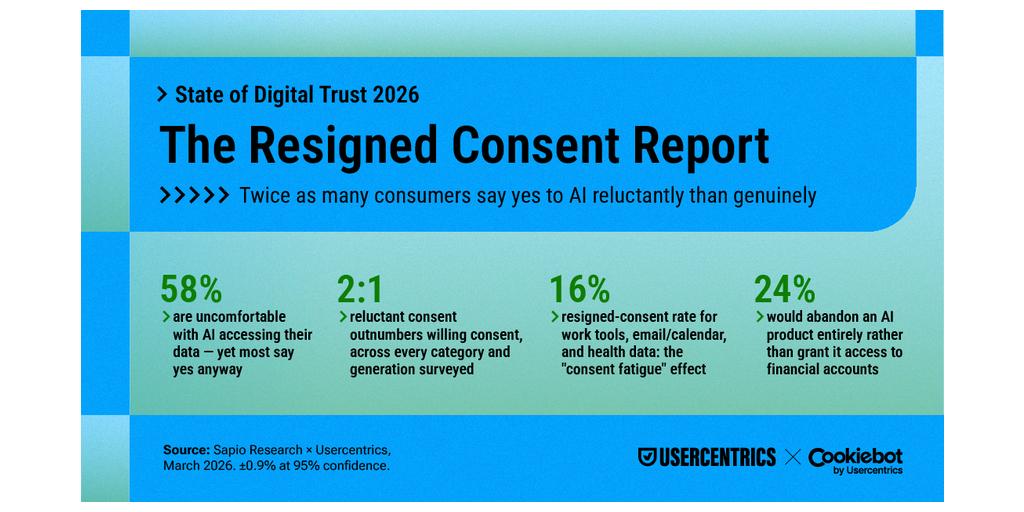



New findings from Usercentrics' State of Digital Trust Research 2026 reveals resignation, not refusal, as the hidden risk behind AI adoption numbers, with German consumers granting access more reluctantly than any market surveyed.
MUNICH: Nearly six in ten consumers are uncomfortable letting an AI assistant access their data. Most of them say yes anyway, and new global research shows a large share of that "yes" is based on resignation, not trust.
According to the new findings based on a study of 11,000 consumers across seven markets conducted by Sapio Research, just 7% of consumers are fully comfortable granting an AI assistant access to their data with no conditions attached. More than twice as many, 17%, grant that access despite feeling uncomfortable about it: a pattern the report calls "resigned consent," permission given not because the request feels right, but because refusing feels like more trouble than it's worth.
The distinction matters because access rates and consent quality are being read as the same signal, when they are not. A resigned yes and a genuine one register identically in a consent rate. They do not behave the same way afterward.
"A resigned yes and a real one look identical in your consent rate, but behave nothing alike," said Tilman Harmeling, Strategy & Market Intelligence at Usercentrics. "One holds under pressure. The other holds until the first bad headline. If you can't tell which one you have, you don't know how much of your AI adoption is actually yours to keep."
The findings arrive as businesses across sectors expand AI assistants, copilots and agents into systems that touch consumer and employee data, often citing high opt-in or access rates as evidence the rollout is landing well.
Key findings:
- Reluctant consent outnumbers willing consent more than two to one, across every data category and every generation surveyed. The only variable that changes the pattern is country.
- Germany is the most reluctant "yes" of any market surveyed. German consumers post a 24% resigned-consent rate, more than double the UK's (11%) and the US's (10%). Germany is also the least likely market to refuse outright (16%, against a 23% global average). It is the most likely market to say yes, and the least likely to mean it unreservedly.
- The highest-stakes data gets the clearest answers. Financial accounts draw the most discomfort (64%) but the lowest resigned consent (14%). When the ask is big enough, people don't grudgingly comply. Nearly a quarter (24%) would abandon the AI product entirely rather than grant it financial access.
- Everyday categories hide the most resignation. Work tools, email/calendar and health data, the categories people are asked about most often, post the highest resigned-consent rates (17%), consistent with "consent fatigue," where repeated requests wear down active engagement without reducing underlying discomfort.
- Even the youngest users aren't more willing, just less likely to refuse. Among consumers who say yes, roughly a quarter to a third are resigned in every generation, Gen Z included. Age doesn't decide how reluctant a "yes" is; it decides how often someone gets to yes at all.
"The goal isn't a higher yes rate. It's a more honest one. A considered yes from fewer people holds up better than a reluctant yes from many, which is exactly what we see in the UK and US," said Harmeling.
The full Resigned Consent Report is available here.
For the wider research, see the full State of Digital Trust Report 2026 - with country-by-country and generational breakdown.
About the research
The State of Digital Trust Report 2026 is the second annual study commissioned by Usercentrics and conducted by Sapio Research. The survey polled 11,000 consumers across seven markets: the UK, USA, Germany, Spain, Italy, the Netherlands and Sweden. Fieldwork was conducted in March 2026 and is accurate to ±0.9% at 95% confidence. Sweden joins the study for the first time this year; year-on-year comparisons exclude Swedish data.
About Usercentrics
Usercentrics is a leading data privacy technology company that helps businesses collect, manage, and activate consented data with confidence. Trusted by 2.4 million websites and apps across 195 countries, the company processes more than 8.8 billion user consents every month. Through its platform, which spans consent management, server-side tagging, and AI data connectivity and access, Usercentrics gives businesses the compliance infrastructure to grow, innovate, and operate responsibly in an AI-first world. Learn more at usercentrics.com.
Fonte: Business Wire
Related news

Last News
RSA at Cybertech Europe 2024
Alaa Abdul Nabi, Vice President, Sales International at RSA presents the innovations the vendor brings to Cybertech as part of a passwordless vision for…
Italian Security Awards 2024: G11 Media honours the best of Italian cybersecurity
G11 Media's SecurityOpenLab magazine rewards excellence in cybersecurity: the best vendors based on user votes
How Austria is making its AI ecosystem grow
Always keeping an European perspective, Austria has developed a thriving AI ecosystem that now can attract talents and companies from other countries
Sparkle and Telsy test Quantum Key Distribution in practice
Successfully completing a Proof of Concept implementation in Athens, the two Italian companies prove that QKD can be easily implemented also in pre-existing…
Most read
Generative AI Becomes the New Standard for Legal Work in Just Four Years,…
Everlaw, the AI-powered litigation and investigation platform, today released its 2026 Legal AI Adoption & Impact Report, revealing that generative…
Owl Labs’ 2026 State of Hybrid Work Report Finds UK Employees Are Caught…
AI use is now near-universal across the UK workforce, office policies are continuing to shift, and employees are reporting higher levels of stress, according…
GigaDevice Brings “Intelligence at the Edge” to Embedded World North America,…
#Connectivity--GigaDevice, a leading semiconductor company specializing in Flash memory, 32-bit microcontrollers (MCUs), sensors, and analog products,…
VerifyMe Announces Reverse Stock Split of the Company’s Common Stock
VerifyMe, Inc. (NASDAQ: VRME) (“VerifyMe”), a provider of authentication and precision logistics technologies today announced a planned reverse stock…
G11 Media Networks

InnovationOpenLab is a channel of BitCity, a newspaper registered at the court of Como ,
n. 21/2007 del
11/10/2007- Registration ROC n. 15698
G11 MEDIA S.R.L.
Registered office Via NUOVA VALASSINA, 4 22046 MERONE (CO) - P.IVA/C.F.03062910132
Como business register n. 03062910132 - REA n. 293834 CAPITALE SOCIALE Euro 30.000 i.v.