Law Firms Turn to Phala's Confidential Compute to Bridge AI Trust Gap
#AICompliance--When partners at a California law firm floated the idea of using generative AI to draft briefs and summarize case law, their IT department blocked the plan. The reason: feeding client d...
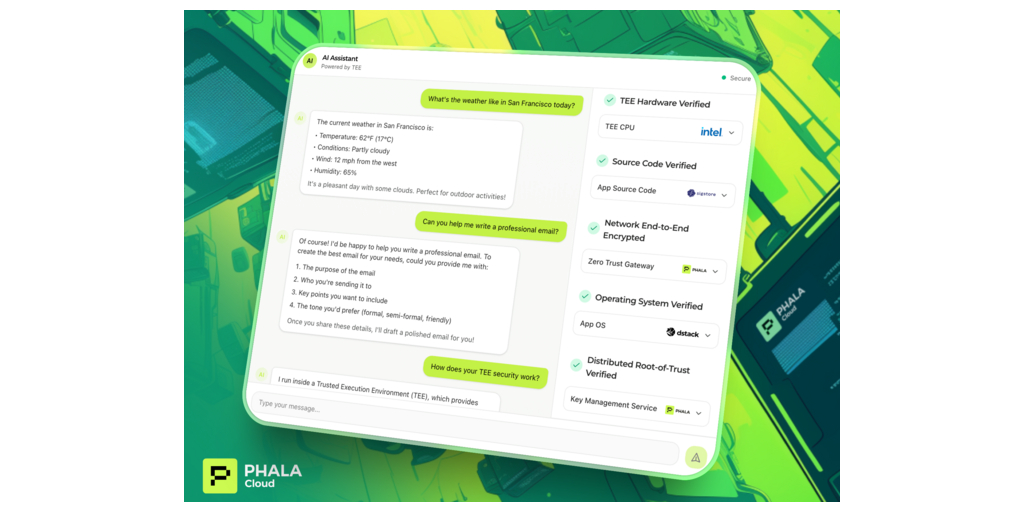



As privacy rules tighten, secure infrastructure becomes the new gatekeeper for attorneys wary of exposing client data to language models.
SAN FRANCISCO: #AICompliance--When partners at a California law firm floated the idea of using generative AI to draft briefs and summarize case law, their IT department blocked the plan. The reason: feeding client data into public AI models could expose privileged information and violate bar rules. The promise of faster research collided with the profession’s deepest taboo: confidentiality.
After months of evaluation, the firm piloted a confidential-compute platform from Phala - one of several emerging infrastructure providers building “trust layers” for AI. The system allows models to process encrypted data inside secure enclaves, where information remains sealed even from the infrastructure operator itself.
“It gave us verifiable proof that no information ever left our control,” said one partner involved in the pilot. “That changed the conversation from can we use AI? to how safely can we deploy it?”
AI Adoption Meets Legal Ethics
Both the American Bar Association’s Formal Opinion 512 (2024) and the California Bar’s Practical Guidance on Generative AI (2023) reaffirm that attorneys remain responsible for maintaining confidentiality, competence, and supervision when using third-party AI systems. These requirements have left many firms unable to leverage modern tools that rely on external data processing.
Confidential computing offers a new compliance path. By isolating AI models in secure enclaves and generating cryptographic attestation-verifiable proof of where and how data is processed-firms can demonstrate control over sensitive information during every stage of an AI workflow.
From Experiment to Standard Practice
In the California pilot, the firm deployed Phala’s confidential AI for document review and case analysis. Attorneys could spin up private model instances by the hour, process discovery materials securely, and generate summaries in minutes. All data remained encrypted end-to-end, and the firm received automated attestation reports for audit purposes.
The results:
- 100% compliance with state bar confidentiality rules
- 40% faster document review
- Predictable costs through hourly, isolated model use
“The legal profession is realizing that privacy-by-design infrastructure is not just a cybersecurity measure-it’s a business enabler,” said Marvin Tong, CEO at Phala.
A Broader Shift in Enterprise AI
The trend extends far beyond law. Healthcare providers, banks, and insurers are adopting confidential compute to meet data-protection standards while using generative AI for research, analytics, and claims processing. Analysts expect the global confidential computing market to exceed $70 billion by 2030, driven by increased regulatory scrutiny and demand for verifiable privacy.
Recent guidance from the European Data Protection Board (EDPB) also supports this direction, calling for “computational locality” and traceable data governance in AI systems. Confidential computing delivers those guarantees by ensuring that sensitive workloads remain sealed, verified, and geographically contained.
About Phala
Phala is a privacy infrastructure company building the foundation for confidential AI and data processing. By leveraging hardware-secured enclaves and blockchain-based attestation, Phala enables organizations to process sensitive workloads in a verifiable, privacy-preserving way. The company’s enterprise platform integrates with standard cloud and software ecosystems to bring confidential computing to regulated industries worldwide.
Learn more at phala.com.
Fonte: Business Wire
Related news

Last News
RSA at Cybertech Europe 2024
Alaa Abdul Nabi, Vice President, Sales International at RSA presents the innovations the vendor brings to Cybertech as part of a passwordless vision for…
Italian Security Awards 2024: G11 Media honours the best of Italian cybersecurity
G11 Media's SecurityOpenLab magazine rewards excellence in cybersecurity: the best vendors based on user votes
How Austria is making its AI ecosystem grow
Always keeping an European perspective, Austria has developed a thriving AI ecosystem that now can attract talents and companies from other countries
Sparkle and Telsy test Quantum Key Distribution in practice
Successfully completing a Proof of Concept implementation in Athens, the two Italian companies prove that QKD can be easily implemented also in pre-existing…
Most read
Deepgram Brings Low-Latency Speech Recognition and TTS to Amazon Connect
Deepgram, the world’s most realistic and real-time Voice AI platform, today announced integration of its enterprise-grade speech-to-text (STT) and text-to-speech…
Deepgram Launches Streaming Speech, Text, and Voice Agents on Amazon SageMaker…
Deepgram, the world’s most realistic and real-time Voice AI platform, today announced native integration with Amazon SageMaker AI, delivering streaming,…
MathWorks Showcases AI for Safety-Critical Systems at NeurIPS 2025
NeurIPS 2025, Booth #732 – MathWorks, the leading developer of mathematical computing software, will showcase how engineers and scientists can use MATLAB®…
CORRECTING and REPLACING Block Processes 124 Million Transactions as Americans…
In Lower West Side, Chicago section, first bullet point should read: Total BFCM Weekend Volume: $8.4M (instead of Total BFCM Weekend Volume: $49M). The…
G11 Media Networks
InnovationOpenLab is a channel of BitCity, a newspaper registered at the court of Como ,
n. 21/2007 del
11/10/2007- Registration ROC n. 15698
G11 MEDIA S.R.L.
Registered office Via NUOVA VALASSINA, 4 22046 MERONE (CO) - P.IVA/C.F.03062910132
Como business register n. 03062910132 - REA n. 293834 CAPITALE SOCIALE Euro 30.000 i.v.