
75% of Homebuyers Expect AI in Process but Still Want “Human in the Loop”
75% of buyers assume AI plays a role in the homebuying process, according to a new study from Cotality. With more than $2 trillion in mortgage originations each year in the United States, even modest ...
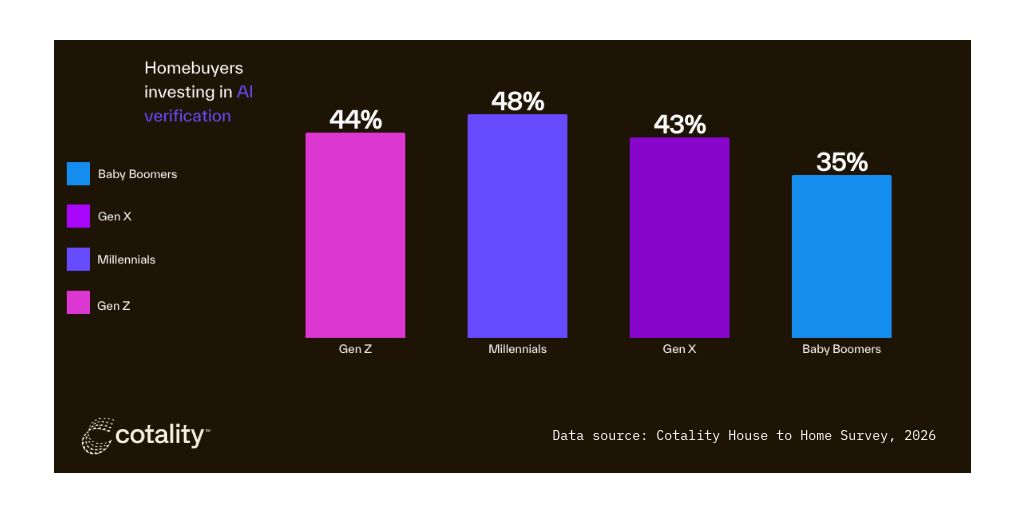



- U.S. homebuyer confidence has fallen from 83% to 72% year-on-year
- Half of Gen Z see AI as key to navigating today’s market
- 44% of homebuyers would pay for a human expert to verify AI decisions
IRVINE, Calif.: 75% of buyers assume AI plays a role in the homebuying process, according to a new study from Cotality.
With more than $2 trillion in mortgage originations each year in the United States, even modest improvements in efficiency could have significant implications for lenders and homebuyers alike. Cotality finds AI-driven workflows could shorten mortgage processing times by one to three months - helping buyers move into homes faster while enabling lenders to recycle capital more efficiently and increase capacity.
But as AI adoption grows, trust is becoming harder to earn - particularly in the U.S. The international study is the first of its kind to examine consumer sentiment toward AI’s role across the end-to-end homebuying journey.
AI already assumed to be embedded across homebuying process
At least three-quarters of buyers assume AI is already embedded in the housing ecosystem. Buyers most expect AI in property websites (86%), insurers (82%) and lenders (80%), with agents (80%) and brokers (79%) close behind.
However, a generational divide remains. 70% of Baby Boomers assume AI is embedded in the process, compared to 84% of Millennials and 81% of Gen Z.
Younger buyers want AI support as confidence falls
U.S. buyer confidence in navigating the homebuying process has fallen from 83% in 2025 to 72% today, while the share actively saving for a home has declined from 75% to 69%.
Younger buyers are more likely to see AI as part of the solution: 50% of Gen Z say it would increase their confidence in buying a home, compared with 40% of Millennials, 33% of Gen X, and 21% of Baby Boomers. Gen Z buyers also report a greater need for speed, particularly when securing legal assistance (46%) and insurance (39%).
In the U.S., 37% of originated loans are attributed to buyers under 35, highlighting the growing influence of younger buyers - and the need for faster AI-enabled experiences to match their expectations.
“Homebuyers want the speed and scale of AI - but not at the expense of certainty,” Amy Gromowski, Head of Data Science at Cotality said. “With AI adoption accelerating the homebuying process across the United States, over 7 million mortgages are originated annually - representing several trillion dollars in combined lending volume each year. If AI-powered workflows shorten time to close by just one to three months, lenders can pull forward billions in repayments, recycle capital more efficiently, and expand capacity without increasing headcount.”
Trust gap widens as AI expectations rise
68% of buyers say clear AI labeling for property listings and mortgage recommendations is important or essential, and 37% say it should be mandatory - rising to 61% among Baby Boomers.
In the U.S., trust in AI to help find a home has fallen by 14 percentage points from 30% in 2025 to 16% in 2026.
Buyers also want greater control over how AI is used. Nearly half (46%) say it is unacceptable for lenders or insurers to conduct automated AI valuations without prior approval. Tolerance for AI mistakes is notably low - just 22% of Gen Z and 19% of Millennials say they are tolerant of AI errors, compared with 11% of Gen X and 9% of Baby Boomers.
Buyers want more transparency and stability in AI recommendations
AI-driven financial processes are also triggering stability concerns, with 64% of buyers concerned that AI may "recycle" unverified information rather than use validated, first-party data.
That desire for transparency is reflected in each generation's willingness to accept its outputs. Only 7% of global Gen Z homebuyers would accept AI-generated information on property risk and its subsequent effects on premiums. Millennials have a higher tolerance with 12% willing to accept and act upon AI-generated information about their home's safety. U.S and UK buyers appear most willing to adopt AI-generated information, with 11% and 10% of buyers saying they are comfortable, compared to 3% in Canada.
US buyers increasingly value the human element
While nearly half (48%) of buyers globally consider AI reliable for making fair lending decisions, preference for working with human professionals has risen across every major task in the U.S.
55% of U.S. buyers would prefer working with a person to secure a mortgage, compared with 46% last year. Two-thirds (66%) would rely on human professionals over AI for legal assistance (up from 54% in 2025), while 56% say they would trust a human expert’s guidance over AI when assessing natural disaster risk.
Although buyers are open to digital simulations to understand climate risk, they still want a human “safety net” when acting on that information. In fact, 44% of respondents say they would pay an additional fee to have a human expert verify AI-generated housing decisions.
“Buyers are not rejecting AI; they are asking for safeguards,” said Amy Gromowski. “They recognize AI’s power to process massive datasets and speed up decisions. But when it comes to the largest financial transaction of their lives, accuracy and accountability are non-negotiable.”
To read the full AI in Housing 2026 Report, visit the Cotality website.
About the Report
Cotality surveyed homebuyers in the U.S., Canada, the U.K., and Australia between January 29 and February 9, 2026. The sample split between recent buyers (purchased within five years) and prospective buyers (planning to purchase within two to five years), with generational coverage across Gen Z, Millennials, Gen X, and Baby Boomers.
About Cotality
Cotality accelerates data, insights, and workflows across the property ecosystem to enable industry professionals to surpass their ambitions and impact society. With billions of data signals across the life cycle of a property, we unearth hidden risks and transformative opportunities for agents, lenders, carriers, and innovators. Get to know us at cotality.com.
Fonte: Business Wire
Related news

Last News
RSA at Cybertech Europe 2024
Alaa Abdul Nabi, Vice President, Sales International at RSA presents the innovations the vendor brings to Cybertech as part of a passwordless vision for…
Italian Security Awards 2024: G11 Media honours the best of Italian cybersecurity
G11 Media's SecurityOpenLab magazine rewards excellence in cybersecurity: the best vendors based on user votes
How Austria is making its AI ecosystem grow
Always keeping an European perspective, Austria has developed a thriving AI ecosystem that now can attract talents and companies from other countries
Sparkle and Telsy test Quantum Key Distribution in practice
Successfully completing a Proof of Concept implementation in Athens, the two Italian companies prove that QKD can be easily implemented also in pre-existing…
Most read
Roblox Announces Roblox Plus, a New Subscription Plan Offering Exclusive…
Roblox (NYSE: RBLX) today announced Roblox Plus, a new subscription plan designed to deliver more value to its users. Available globally starting April…
SS&C to Release First Quarter 2026 Earnings
SS&C Technologies Holdings, Inc. (Nasdaq: SSNC), a global provider of services and software for the financial services and healthcare industries,…
Western Union to Release First Quarter 2026 Results on April 24, 2026
The Western Union Company (NYSE: WU) announced today that Chief Executive Officer, Devin McGranahan, and Chief Financial Officer, Matt Cagwin, will host…
Blackstone Digital Infrastructure Trust Announces Public Filing of Registration…
Blackstone Digital Infrastructure Trust Inc., a newly organized company focused on acquiring and owning stabilized, newly-constructed data centers, announced…
G11 Media Networks

InnovationOpenLab is a channel of BitCity, a newspaper registered at the court of Como ,
n. 21/2007 del
11/10/2007- Registration ROC n. 15698
G11 MEDIA S.R.L.
Registered office Via NUOVA VALASSINA, 4 22046 MERONE (CO) - P.IVA/C.F.03062910132
Como business register n. 03062910132 - REA n. 293834 CAPITALE SOCIALE Euro 30.000 i.v.