
Omdia: Mainland China Cloud Infrastructure Spending Rises 26% in Q4 2025, Driven by AI and Agent Growth
#AI--Mainland China’s cloud infrastructure services spending reached $14.7 billion in Q4 2025, up 26% year-on-year, according to new research by Omdia. This marked a continued acceleration from the ...
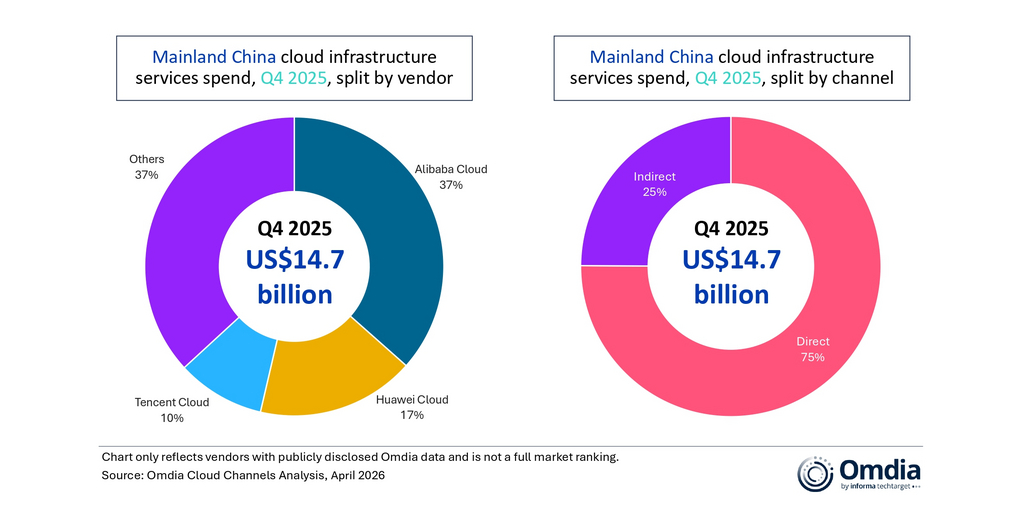



LONDON: #AI--Mainland China’s cloud infrastructure services spending reached $14.7 billion in Q4 2025, up 26% year-on-year, according to new research by Omdia. This marked a continued acceleration from the previous quarter and the third consecutive quarter of growth above 20%. Looking ahead, Omdia forecasts that China’s cloud infrastructure services spending will grow by 26% in 2026.
In Q4 2025, AI remained the market’s primary growth driver, but its impact expanded beyond model-related demand to support broader cloud infrastructure consumption and enterprise deployment capabilities. At the same time, market attention is shifting from models themselves toward product forms such as agents that are more closely aligned with real-world business processes. Competition is increasingly centered on product readiness, operational capability, and the depth of scenario integration. As AI adoption moves closer to real business workflows, collaboration across the broader ecosystem is also set to play a more important role.
Mainland China’s cloud infrastructure services market continued to recover in Q4 2025, posting 26% year-on-year growth. AI-related demand remained the central growth driver. As enterprise AI adoption deepened, market growth was increasingly supported not only by model usage, but also by the broader rollout of enterprise AI, the expansion of private AI deployments, and rising demand for traditional cloud resources such as compute, storage, and databases.
“This reflects a broader shift in the role of AI, from a standalone technical capability into a wider driver of infrastructure demand,” said Rachel Brindley, Senior Research Director at Omdia. “As enterprises embed AI across a wider range of real-world business scenarios, deployment models, data environments, and operational frameworks are becoming increasingly complex. As a result, demand for cloud resources is extending beyond model consumption to the broader infrastructure layer.”
AI commercialization is also gradually evolving beyond chatbot-style applications toward execution-oriented applications, particularly agents. The rapid emergence of OpenClaw in China has further heightened market attention on this shift. More importantly, it has given the market a clearer view of how agents can connect workflows, tool use, and external systems through conversational interfaces, while being packaged into product forms that are more closely aligned with business process.
“As conversational interfaces, workflows, and enterprise systems are increasingly integrated into the invocation and execution chain of agents, the focus of market competition is beginning to shift,” said Yi Zhang, Senior Analyst at Omdia. “It is moving beyond models and platform capabilities alone toward the deliverability and operational maturity of agent products, as well as the depth of their integration with real-world business scenarios.”
As this shift becomes more visible, China’s leading cloud vendors are responding in different ways, with each placing emphasis on different parts of the emerging agent landscape. Tencent Cloud is emphasizing the value of the interface layer, accelerating its agent product strategy around mainstream instant messaging platforms and its broader ecosystem, while exploring how messaging and chat interfaces can evolve into points of invocation and execution for agents. Alibaba Cloud is placing greater emphasis on the enterprise platform layer, strengthening enterprise-grade agent platforms and workflow execution capabilities to support agent adoption across business processes. Huawei Cloud, meanwhile, continues to advance AI deployment through industry scenarios, with a stronger emphasis on the integrated development of models, platforms, and solution capabilities.
As agents move closer to real business processes, ecosystem collaboration is becoming more important. In Q4 2025, partner-driven cloud revenue accounted for 25% of the market, with the share expected to rise further as partners help translate AI adoption into business value.
Alibaba Cloud held a 37% share of China’s cloud infrastructure market in Q4 2025, maintaining its lead, while revenue from AI-related products recorded triple-digit year-on-year growth for the tenth consecutive quarter. During the quarter, Alibaba Cloud continued to strengthen its AI full stack portfolio through the launch of Qwen3.5 and further enhancements to its Model Studio platform (Bailian). The latest updates expanded support for agent development and multimodal knowledge management, while adding capabilities such as long-term memory, data connectors, templates, and MCP services. These enhancements helped drive a sixfold increase in average daily token consumption for public model APIs on Model Studio over a three-month period. Alibaba Cloud also launched Wukong, an enterprise-grade AI-native agent platform, extending its model and platform capabilities into more practical enterprise AI deployment. Separately, it expanded its regional infrastructure footprint by opening its fourth data center in Japan in March.
Huawei Cloud remained the second-largest cloud infrastructure provider in China in Q4 2025, with a 17% market share. During the quarter, Huawei Cloud continued to advance its AI strategy through a combination of industry-focused deployment and broader ecosystem support. In February, Huawei Cloud launched its Industry AI Foundry initiative for smart healthcare. As part of this push, it also introduced a cloud-edge-device smart pathology solution that brings together models, platforms, and solution capabilities to accelerate AI adoption in the medical sector. Huawei Cloud also launched the CodeArts coding agent, an engineering-oriented intelligent coding solution for developers and enterprises, with its user base growing sevenfold since public beta. In March, Huawei Cloud further expanded support for AI ecosystem partners by updating its partner policy in China and launching a CNY 200 million ($28.9 million) AI ecosystem fund.
Tencent Cloud held an estimated 10% share of China’s cloud infrastructure market in Q4 2025. It further advanced its agent strategy from development capabilities toward more practical productization and deployment. In January, Tencent Cloud upgraded its agent development platform (ADP), with enhanced support for multi-agent orchestration, GraphRAG, plugin ecosystems, and engineering capabilities. It also launched products including WorkBuddy and QClaw, expanding its agent portfolio across a broader range of usage scenarios. At the end of March, Tencent Cloud released its first agent product landscape and upgraded its MaaS platform to TokenHub, further integrating these products and capabilities into a more unified agent offering. On the infrastructure side, Tencent Cloud also announced plans to add a new cloud availability zone in Frankfurt, further strengthening its presence in Europe.
Omdia defines cloud infrastructure services as the sum of bare metal as a service (BMaaS), infrastructure-as-a-service (IaaS), platform-as-a-service (PaaS) and container-as-a-service (CaaS) and serverless that are hosted by third-party providers and made available to users via the Internet.
ABOUT OMDIA
Omdia, part of TechTarget, Inc. d/b/a Informa TechTarget (Nasdaq: TTGT), is a technology research and advisory group. Our deep knowledge of tech markets grounded in real conversations with industry leaders and hundreds of thousands of data points, make our market intelligence our clients’ strategic advantage. From R&D to ROI, we identify the greatest opportunities and move the industry forward.
Fonte: Business Wire
Related news

Last News
RSA at Cybertech Europe 2024
Alaa Abdul Nabi, Vice President, Sales International at RSA presents the innovations the vendor brings to Cybertech as part of a passwordless vision for…
Italian Security Awards 2024: G11 Media honours the best of Italian cybersecurity
G11 Media's SecurityOpenLab magazine rewards excellence in cybersecurity: the best vendors based on user votes
How Austria is making its AI ecosystem grow
Always keeping an European perspective, Austria has developed a thriving AI ecosystem that now can attract talents and companies from other countries
Sparkle and Telsy test Quantum Key Distribution in practice
Successfully completing a Proof of Concept implementation in Athens, the two Italian companies prove that QKD can be easily implemented also in pre-existing…
Most read
Gartner Forecasts Worldwide IT Spending to Grow 13.5% in 2026, Totaling…
Worldwide IT spending is expected to reach $6.31 trillion in 2026, up 13.5% from 2025, according to the latest forecast by Gartner, Inc., a business and…
Thiel Foundation Announces 2026 Class of Thiel Fellows
Today, The Thiel Foundation has officially unveiled its 2026 class of Thiel Fellows, rewarding an ambitious and bright class of young people ready to…
Josh Stephens Joins Huper as VP of Engineering
Huper Corporation today announced the appointment of Josh Stephens as VP of Engineering, to lay the engineering foundation of the product, bring maturity…
Conductor Launches Enterprise AgentStack to Power the Next Era of AI Visibility
#AEO--Conductor, the only end-to-end enterprise AEO platform, today announced AgentStack, a new enterprise suite of native LLM apps, developer infrastructure,…
G11 Media Networks

InnovationOpenLab is a channel of BitCity, a newspaper registered at the court of Como ,
n. 21/2007 del
11/10/2007- Registration ROC n. 15698
G11 MEDIA S.R.L.
Registered office Via NUOVA VALASSINA, 4 22046 MERONE (CO) - P.IVA/C.F.03062910132
Como business register n. 03062910132 - REA n. 293834 CAPITALE SOCIALE Euro 30.000 i.v.