Striding AI Unveils Physical AI Solution for 24/7 Retail at APRCE 2026
On October 8, 2026, Striding AI unveiled its Physical AI solution for retail, including two self-developed robots and a robot management platform, at the 22nd Asia-Pacific Retailers Convention & E...
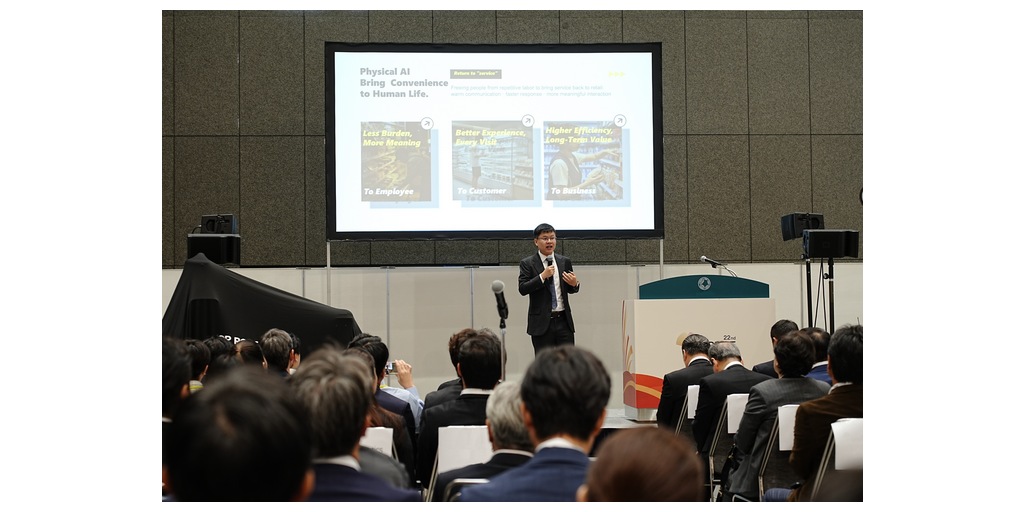


SINGAPORE: On October 8, 2026, Striding AI unveiled its Physical AI solution for retail, including two self-developed robots and a robot management platform, at the 22nd Asia-Pacific Retailers Convention & Exhibition (APRCE 2026).
Designed for human-robot collaboration in real-world retail environments, the solution automates carrying, shelf replenishment, inventory checks, and patrols, allowing employees to focus on customer service. Robots can also undertake repetitive overnight work, reducing the need for late-night employee shifts while supporting 24/7 convenience-store operations. Retail presents particular challenges for robotics, including extensive product assortments, dense shelving, narrow aisles, changing merchandising conditions, and frequent customer interactions.
Under reported deployment conditions, the system completes up to 99% of tasks autonomously, covering task assignment, perception, navigation, object recognition, grasping, and execution, with human intervention when needed.
“Retail is one of the most complex and dynamic environments for robots to operate in, with diverse products, changing workflows, and frequent human interaction. By bringing Physical AI into real retail environments, we can continuously learn from deployment and turn real-world experience into more capable robotic systems,” said Song Yao, Founder and CEO of Striding AI, during his keynote, “Physical AI and the Future of 24/7 Retail.”
An Integrated “Embodied Brain” for Physical AI That Continuously Learns from Real-World Tasks
Striding AI’s system-first approach combines foundation models, robotic perception and control, real-world action data, robot hardware, and deployment infrastructure. Its “Embodied Brain” integrates world-action models, reinforcement learning, embodied agents, and agentic infrastructure to help robots to perceive, reason, act and improve through real-world interaction.
Its SLM-0.5 (Latent World Action Model) generates actions in latent space rather than through repeated pixel-level prediction, reducing computing requirements and latency. Under reported evaluation settings, it achieved 98.6% success on LIBERO and 91.22% on RoboTwin, with 187 ms latency per action chunk - up to 24 times lower than comparable pixel-space world-action models.
STEAM uses reinforcement learning and human feedback in an execution-feedback-learning-redeployment loop, allowing robot policies to improve from actual operations rather than relying only on pre-collected training data.
RPent (Recursive Physical Agent) provides infrastructure integrating perception, reasoning, memory, execution, and self-evolution across different foundation models, action primitives, simulation environments, and robot platforms.
Robots and Infrastructure Designed for Real-World Retail
The solution is designed for real-world retail environments, enabling robots to operate alongside people and adapt to existing store layouts, workflows, and operating conditions.
Deployment is designed to minimize modifications to existing store environments, with site-specific requirements assessed before deployment.
H1 humanoid robot supports customer greetings, guidance, and operational assistance through multimodal interaction. It supports more than 20 languages, 45 facial expressions, 36 gestures, and an open API for integration.
C1 mobile manipulator handles transport, replenishment, loading, and unloading in narrow store aisles. Its slim omnidirectional chassis supports working heights from 100 mm to over 1,750 mm. Front and rear depth sensors, 360-degree vision, and emergency braking for obstacles detected within 30 cm support operation in retail settings.
The M1 robot management platform coordinates multi-robot deployment, task management, monitoring, and performance review. Edge autonomy allows core functions, including navigation, task execution, and grasping, to operate locally without continuous real-time connectivity; network access supports monitoring and human intervention. Deployments are designed to minimize store modifications, subject to site-specific assessment.
Striding AI also plans to further expand its lineup with heavy-duty models and the A1 precision-manipulation robot for tasks such as checkout and bagging. The expanded lineup is intended to support a range of applications, from general-purpose mobile manipulation and dexterous tasks to heavy-duty operations.
From Scenario Co-Creation to Commercial Deployment
Striding AI plans to work with leading global retail chains to validate and refine the system in real-world stores, expanding applications to hot-food preparation, inventory management, delivery sorting, and packaging.
Commercial services are planned for 2027, through direct purchase or Robotics-as-a-Service (RaaS) subscriptions covering hardware, software, operations, and ongoing upgrades. The company aims to scale deployment of Physical AI through global retail partners before expanding to other industries.
About Striding AI
Founded in 2026, Striding AI develops full-stack Physical AI systems combining world-action models, reinforcement learning, embodied agents, robotics, and deployment infrastructure.
Guided by its mission, “Bring Ease to the World with Physical AI,” its full-stack R&D team spans foundation models, reinforcement learning, embodied agents, motion control, human-robot interaction, embedded software, humanoid robot design, scenario solutions, manufacturing, and deployment. The company focuses on the co-evolution of real-world data, algorithms, and infrastructure to build systems that improve at scale.
Striding AI operates across Singapore, Tokyo, Beijing, and Shanghai, serving the development and deployment of Physical AI systems across global markets.
Fonte: Business Wire
Related news

Last News
RSA at Cybertech Europe 2024
Alaa Abdul Nabi, Vice President, Sales International at RSA presents the innovations the vendor brings to Cybertech as part of a passwordless vision for…
Italian Security Awards 2024: G11 Media honours the best of Italian cybersecurity
G11 Media's SecurityOpenLab magazine rewards excellence in cybersecurity: the best vendors based on user votes
How Austria is making its AI ecosystem grow
Always keeping an European perspective, Austria has developed a thriving AI ecosystem that now can attract talents and companies from other countries
Sparkle and Telsy test Quantum Key Distribution in practice
Successfully completing a Proof of Concept implementation in Athens, the two Italian companies prove that QKD can be easily implemented also in pre-existing…
Most read
ServiceNow delivers industry-first personal enterprise agent and policy…
NVIDIA GTC — ServiceNow (NYSE: NOW), the Super Intelligence Control Tower for business reinvention, today announced significant updates designed to bring…
Wyze Scale Ultra BodyScan Plus Puts Your Full Body Breakdown at Eye Level
Wyze, a company dedicated to making smart home technology accessible and safe, today announced the Wyze Scale Ultra BodyScan Plus, launching as part of…
Realbotix to Exhibit at CES 2027
Realbotix Corp. (TSX-V: XBOT) (Frankfurt: 76M0.F) (OTC: XBOTF) (“Realbotix” or the “Company”), a leading developer of humanoid robots and AI systems,…
Arda Emerges from Stealth to Speed Up American Manufacturing
Arda Industries today launched from stealth with $232 million in funding to speed up American manufacturing. Its software helps manufacturers quickly…
G11 Media Networks

InnovationOpenLab is a channel of BitCity, a newspaper registered at the court of Como ,
n. 21/2007 del
11/10/2007- Registration ROC n. 15698
G11 MEDIA S.R.L.
Registered office Via NUOVA VALASSINA, 4 22046 MERONE (CO) - P.IVA/C.F.03062910132
Como business register n. 03062910132 - REA n. 293834 CAPITALE SOCIALE Euro 30.000 i.v.