
New Levels of Computation Fidelity for Quantum Computing and Quantum Routing
#AI--OPTICA QUANTUM SUMMIT 2.0-- Quantum Pulse Ventures (QPV) today announced a strategic expansion of its composite pulse photonics platform, to address scalable, low loss integrated optical applicat...
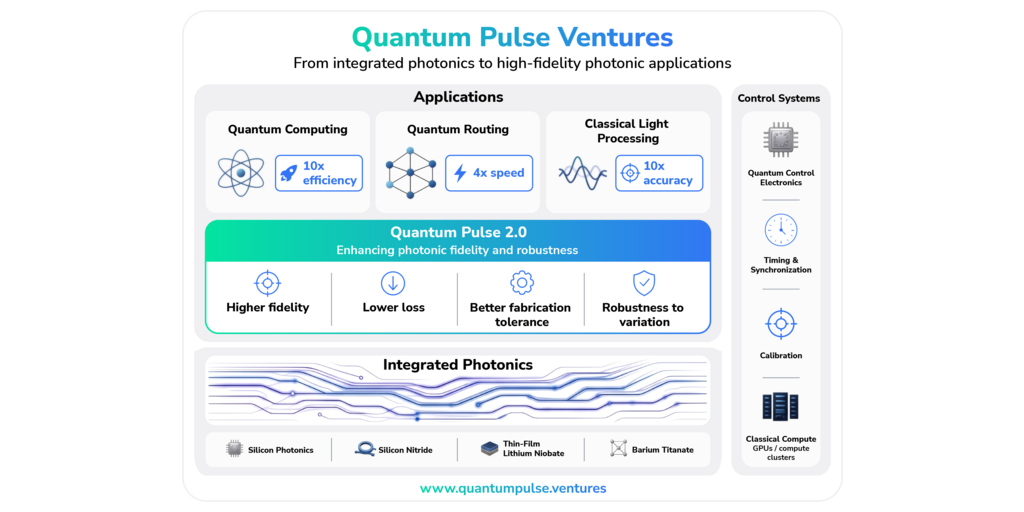



Quantum Pulse Ventures’ Expanded Photonic Infrastructure Platform boosts optical connectivity via scalable, low loss integrated optical applications
GLASGOW, Scotland: #AI--OPTICA QUANTUM SUMMIT 2.0-- Quantum Pulse Ventures (QPV) today announced a strategic expansion of its composite pulse photonics platform, to address scalable, low loss integrated optical applications with unmatched computation fidelity and accuracy for quantum computers and quantum routers. Quantum Pulse 2.0 (QP2.0) extends the company’s offering beyond optical quantum computing components, as part of a broad class of photonic integrated circuits, and is available today.
“Until now, photonics has mostly meant point-to-point communication, with processing and decision-making performed electronically after the light is received,” said Ofer Shapiro, CEO and Co-Founder, Quantum Pulse Ventures. “Next-generation systems break that mold: we are no longer just transmitting light, we are processing it as part of the computation itself. This is a major shift in computing and network architecture. Available now, Quantum Pulse 2.0 means a major boost for leading-edge quantum computation, quantum networking, optical AI infrastructure, or in-network photonic processing.”
Prof. Yaron Oz, Chief Scientist and co-founder of Quantum Pulse Ventures, explains: “Once light becomes part of the computational fabric, every physical imperfection inside the photonic circuit directly impacts the accuracy of the operation. This creates an entirely new level of demand for accuracy, precision, stability, and fabrication tolerance in photonic integrated circuits. While we have several options for the physical implementation of qubits - for quantum routing, there is only one viable option, which is light itself. This is why we are so excited to expand our platform to support these applications.”
Key Benefits:
- 10x reduction in qubit requirement
- Up to a 10x cost advantage in quantum computers
- 4x speed for quantum routers
- 10x more accurate polarization control
Without needing any changes to existing integrated photonics fabrication platforms, QPV’s composite pulse approach improves operational fidelity and robustness against fabrication variability. This enables immediate adoption across current silicon photonics, silicon nitride, thin-film lithium niobate, and related integrated photonics manufacturing processes – a vital consideration as the industry moves toward substantially larger and deeper photonic circuits where accumulated physical errors, yield degradation, and process variation increasingly limit scalability.
According to Jon Pugh, Director of Photonic Integrated Circuits and Quantum Technologies at Optica: "To date, 99.99% of the usage of light in the industry is for classical high speed communication. We are now seeing companies using light in a new way - to affect the computation process. This represents one of the largest architectural shifts in computing and networking infrastructure. As photonic systems continue evolving toward larger-scale analog and quantum operations, component-level accuracy and robustness will become a defining factor in the scalability of future photonic platforms. Realizing this promise will require a new level of accuracy and loss of the photonic system to truly move from ‘communicate by light’ to ‘compute by light’.”
The QP2.0 platform includes a universal directional coupler that delivers an order-of-magnitude improvement in operational fidelity. System designers can apply this gain in one of two ways: cutting the number of physical qubits required per logical qubit tenfold, or holding the qubit count fixed and accelerating computation by the same factor. Applied to cost, this can reduce the price of building a photonic quantum computer by up to 10x, potentially saving up to $900M against a projected $1B cost per PQC.
Quantum Pulse Ventures develops foundational integrated photonics technologies for quantum computing, quantum communication, and advanced optical systems. The company’s platform improves the fidelity, loss, and robustness of critical photonic building blocks, including quantum gates, entanglement operations, Bell-state measurements, polarization control, optical encoding, directional couplers, and polarization beam splitters. By enabling more accurate and scalable photonic components at the circuit level, QPV helps reduce system complexity, lower error rates, and accelerate the transition from optics as a communication medium to optics as a processing platform for quantum and classical photonic applications. The company was founded in 2021 and is based in Israel.
To learn more about the Quantum Pulse 2.0 platform, read Ofer Shapiro’s blog, or go to www.QuantumPulseVentures.com.
On LinkedIn
On X
Fonte: Business Wire
Related news

Last News
RSA at Cybertech Europe 2024
Alaa Abdul Nabi, Vice President, Sales International at RSA presents the innovations the vendor brings to Cybertech as part of a passwordless vision for…
Italian Security Awards 2024: G11 Media honours the best of Italian cybersecurity
G11 Media's SecurityOpenLab magazine rewards excellence in cybersecurity: the best vendors based on user votes
How Austria is making its AI ecosystem grow
Always keeping an European perspective, Austria has developed a thriving AI ecosystem that now can attract talents and companies from other countries
Sparkle and Telsy test Quantum Key Distribution in practice
Successfully completing a Proof of Concept implementation in Athens, the two Italian companies prove that QKD can be easily implemented also in pre-existing…
Most read
SpaceX IPO Available on Raydium from Day One, Tradeable Through the Weekend
$RAY #IPO--Raydium, the highest-volume decentralized exchange on Solana with over $1 trillion in cumulative trading volume, will list tokenized SpaceX…
CoreWeave to Join Nasdaq-100 Index
CoreWeave, Inc. (NASDAQ: CRWV), The Essential Cloud for AI™, today announced it has been selected for inclusion to the Nasdaq-100® Index, and is expected…
EliseAI Hits $200M ARR After Five Consecutive Years of 100% Growth Across…
EliseAI, the AI company automating complex housing and healthcare systems, today announced it passed $200 million in annual recurring revenue (ARR), achieving…
XTIUM Launches XTAI — XTIUM Trusted AI
XTIUM, a global managed services provider delivering secure digital workplaces, managed security, cloud, network, and unified communications solutions,…
G11 Media Networks

InnovationOpenLab is a channel of BitCity, a newspaper registered at the court of Como ,
n. 21/2007 del
11/10/2007- Registration ROC n. 15698
G11 MEDIA S.R.L.
Registered office Via NUOVA VALASSINA, 4 22046 MERONE (CO) - P.IVA/C.F.03062910132
Como business register n. 03062910132 - REA n. 293834 CAPITALE SOCIALE Euro 30.000 i.v.